Showing posts with label prototyping. Show all posts

Sunday, March 17, 2019

Looking at Visitors Looking (and Learning)


I continue in my fervent belief that anyone and everyone who works in a museum should at least spend some time out on the floor observing what visitors do--what they look at, what they say, what they don't look at.   A few weeks ago I spent time observing a prototype exhibit at Maison des Esclaves (the House of Slaves) where the International Coalition of Sites of Conscience is working with the Department of Cultural Heritage of the Government of Senegal, to revitalize the site and its interpretation.  Gorée Island, where Maison des Esclaves is located, is Africa's first World Heritage Site, a place of great importance and meaning.

We produced the prototype exhibit (designed by Studio Tectonic here in the US and produced by Mandarine in Dakar) to learn more about how different audiences made use of different kinds of information and perspectives.  The story of Maison des Esclaves is a complicated one, and one of our goals is to make that complicated story,  based on new information and research, accessible for visitors. We also are connecting the history of the trans-Atlantic slave trade to contemporary issues of slavery, hoping to inspire action on those issues.  This prototype is a capsule version of the full new interpretation.

Here's just a few photos to show what we learned:

People like maps!  In this case, at least two maps allowed visitors to their own place in the larger world:  a very simple map of the transAtlantic slave trade and a map showing the rates of contemporary slavery around the world both got lots of attention.


Exhibit text in two languages has extra value for all kinds of people. One girl, a native French speaker, was very carefully sounding out the English-language text for her father.


People make unexpected meanings.  Evidently, the school opened by LeBron James has a central staircase that greatly resembles Maison des Esclaves.  Did he intend it? Who knows.  But we did hear that discussion.


Visitors love sharing their own perspectives--and they are usually great at connecting past to present. There was also lots of pointing and sharing, as people looked at the exhibit together.


We need to spend additional efforts planning time and space for people to reflect on both the historical and contemporary issues.  These are hard stories.


To our greatest surprise--people of all ages, from all over the world, were reading, intently reading, our exhibition text--even taking photos of the text. The eagerness to know more about this history was really inspiring to us.


We also had a chance to chat with girls from Mariamma Bâ School on the island. They had visited the exhibition the week before and they had so many great ideas, observations and concerns.  So much so that as we were leaving, three girls hustled down the path to share more ideas with us. When I think about our primary audience for the exhibit--it's those girls, those girls who can shape Senegal and the world.


What did you learn in your exhibits today?  No excuses, get out there!

Monday, August 8, 2016

Visitors Make Meaning: From Hilary to Elsa


As with many of you, Nina Simon's new book on relevance is on my must-read list this summer, although I haven't gotten there yet.  But I'm looking forward to digging into her thoughts on relevance, as it's something repeatedly appearing in my own work and something I want to understand more about.

Last week, in some prototyping efforts at The Old Manse, a property of the Trustees, I saw visitors' ability to make relevant connections in action and wanted to reflect on the experience. The Old Manse is a complicated property, with a long, continuous family history.  But it's not just a family site, but a house that overlooked the first battle of the American Revolution and the place where Ralph Waldo Emerson wrote Nature.  There's much to think about in the house but one of our goals in rethinking the interpretation is to better connect these complex stories to visitors of all ages and interests.

What we found was that we didn't need to be explicit about content, but if conversations on a guided tour are opened up, visitors rapidly make their own relevant connections, creating a deeper experience.  Here's a few examples:

In one room, the guide plays the role of William Emerson (1743-1776)  known as the Patriot Preacher, who was chaplain of the Continental Congress. Visitors are asked to play the roles of real Concord residents, coming to ask the minister his opinion.  One twelve year old boy received the card of someone who felt it was hypocritical to own slaves and fight for freedom.  He asked the minister for his opinion and I responded, as the minister,  that I didn't see the hypocrisy, as I own slaves myself. This boy then proceeds to offer an unscripted spontaneous, passionate, articulate defense of freedom for all--no matter their race, color, religion or beliefs.  His parents looked at him surprised, but this young man made it absolutely relevant to today.

In the same space, when an introduction to the house mentioned that Emerson built the house, a visitor asked, "But who really built the house?" --  a question surely prompted by Michelle Obama's speech at the Democratic convention.

Also on the tour, visitors are introduced to Sarah Ripley (1793-1867) brilliant and entirely self-educated, who read seven languages and tutored Harvard undergraduates in the parlor here.  "Today, she could have been president,"  said one older woman on the tour.  No surprise where that comment came from.

One final meaning-making story from the experiments:  in one room, we share the story of newlyweds Nathaniel and Sophia Hawthorne, who thought of their brief time at the Old Manse as a perfect romantic time.  When I asked a tour group what kind of place was romantic to them, one nine year old girl answered quickly, "a cave behind a waterfall."  Surprised, I asked why-- evidently I have not seen Frozen, because a romantic scene happens behind a waterfall (and dating myself, I instantly thought of Daniel Day Lewis in Last of the Mohicans).

In each of these situations, we didn't just share information, nor did we make the explicit connection--we provided space for meaning-making.  This means we have to give up the urge to share everything we know, and it also means that we have to be okay with uncertainty--and sometimes discomfort. It also means that current events may always be a part of the interpretive experience, because it's what visitors are bringing with them.  For more perspective on this meaning-making, check out this post from Nicole Deufel. My time at The Old Manse was also a reminder of the value of prototyping.  Visitors love to be a part of experimentation and that experimentation enables us to refine how we do this kind of work. If we can let go of our urge to control both the narrative and our visitors experience, those visitors will surprise us on a regular basis with their passion, intelligence and curiosity.

Ralph Waldo Emerson wrote, "All life is an experiment. The more experiments you make the better." Experiment away!

Thursday, April 28, 2016

Team Detective: What's Your Team's Spirit?


I'm an avid mystery reader, which I always thought of as leisure, unconnected to work.  But I've been thinking that there is a connection.  Part of any consultant's job is to go into a place and size up the situation quickly.  I'm not looking for footprints or the dog that didn't bark in the night, but I am looking for how a team works together.  I want to find the spirit of an organization as it looks to change in some way.  The changes might be big or small, but my work is almost always with organizations where change is in the wind--and change never happens with one person, it always happens with a team.

There's a great deal of research about teams:  you need introverts and extroverts,  you need leaders, it should be non-hierarchal and on and on.  Every team is different but here's my outsider's view on what helps a team move towards change.


Experimentation

As a consultant, I don't believe that I come with the answers.  I come with questions and the idea that together, we will puzzle out answers.  One way that happens is through experimentation.  Above, Matt Montgomery, Chief Marketing Officer at the Trustees,  becomes a docent as he leads us through a prototype of an Aeolian harp activity at the Old Manse in Concord.  And below,  Girl Scouts tag what matters to them at Juliette Gordon Low's Birthplace (she's the founder of Girl Scouts) in Savannah.  Experimentation accomplishes several things.  It builds team confidence together (and good humor) and it jump-starts a learning process.

Cast a wide net in your experimental process.  The tags are an inspiration from your friendly Museum Anarchist, and I'm definitely stealing Jeanne Vergeront's idea of a designated reader to share with colleagues.


Visitor and Community Centered

The strongest teams understand that interpretive change is not about protecting your turf.  They understand that museums and historic sites exist for community benefit.  Strong teams have a desire to understand their visitors and their communities.  They have empathy for different perspectives and are interested in learning what visitors have to say.  Last week at the Juliette Gordon Low Birthplace we asked scouts what they wanted to see or do, before their experience began.  "Be inspired!"  said several.  What a tremendous challenge those girls have set for us.


Trust and Fear

Below, staff from the Trustees trust that Matt and his group will not lead them astray in a prototype experience, as they are asked to close their eyes and listen.  Trust isn't always this literal, but change is scary, no question and the more teams can build trust together, the better.  At a mid-point in the interpretive planning process at the Harriet Beecher Stowe Center, we began one meeting by talking about our fears for the project. There were many as the change is big. They ranged from lack of funding to timeline to what would current visitors thinking.  Talking about all those fears somehow made them better.  The team had enough trust in each other to share them, and sharing didn't make them go away, but I think it did make them feel less of a burden and we've continued to be attentive to them as interpretive planning moved forward. 


Everybody has a Voice and Everybody Listens

Last week, sitting in Lisa Junkin Lopez's sunlit office in Savannah, I worked with a team who, I think, felt all their voices mattered.  Ideas tumbled out, they built upon one another.  On my second day there, I was stopped in the hall by the head of maintenance, who had been off the day before. She'd read this blog and we had a great conversation about sounds, listening and meaning-making. Ideas come from everywhere, so it's important to create an environment where everyone feels that their contribution can build something stronger.  

This also means understanding differences of all types on a team, and listening to and respecting those differences.

But What About Dysfunctional Teams?

I'd love to say that every client is a dream team, but unfortunately not. Here's a couple things I've observed that will slow down your team's ability to cope with change.
  • Body language:  arms crossed, eye rolling, unwillingness to participate in small group activities.  We all should know better.
  • "We already do that, we've already done that, that will never work."  No need to say more.  That never moves anything forward.
  • Unclear decision-making process.  That's frustrating for everyone, and that's a place where a leader needs to lead.
  • Perfectionism.  It sounds trite, but perfect is the enemy of good.  We work in places with so many variables, including our many visitors.  We need to do our best, but honestly, we cannot perfect visitor experiences for every visitor because every visitor brings so much to the visit.
How's your team culture?  (and, in a brief commercial, if you want to talk interpretive change at your organization, be in touch!)


Tuesday, June 16, 2015

Underestimating Our Visitors: Part 2


It's hard to believe that it's been two years since I shared Shannon Burke's observation about visitors gained during a prototyping day at the Harriet Beecher Stowe Center.  She noted that we tend to both over-estimate our visitors' knowledge and underestimate what they're up for.   This past weekend I was back at Stowe Center, doing more prototyping and was reminded of the underestimating part--and why prototyping is always, always, worth it.

In the interpretive planning for the new experience at the Stowe House, we'd been struggling with how to convey the impact that Uncle Tom's Cabin made in its initial publication as a serial in the National Era.  Our designer, Roger Westerman, came up with a suggestion--an audio installation that conveyed the sense of one voice reading, then another, then an entire room filled with voices reading the book.

And here's why you prototype.  We weren't at all convinced (okay, Emily was)  that this would work so we decided to give it a try, on Stowe's birthday celebration, when there were many visitors. Rather than audio, we decided to try it as a participatory activity. After a brief (very brief--that's another lesson we're continually learning) introduction and passing out of an typed excerpt,  I read a sentence from a chapter.  I asked one person to join me in reading, and then invited the whole group to read along.  Our groups were amazingly varied that day:  from a high school basketball team, to seniors, to international visitors.  And they did!  Not only did they read along, but when we did a debrief, they talked about not only their understanding but also about what it felt like to them.

They absolutely understood, through their own voices, the sense of the words spreading across the country, from person to person.   But equally importantly, they felt valued and cared for.  One visitor said that he'd never had the opportunity to use his voice on a tour, and loved it.  Another likened it to church, in a sense of fully participating.  In that vein, a clergyman offered us some good advice about enhancing the experience from his own work.  One person said she loved to read aloud; another said she hated it, but because I didn't make anyone read but made it optional, and in a group, that she felt comfortable doing it.  

Do we still need an audio installation?  Maybe not.  Our simple prototype taught us that the collective experience is really what matters.

But here's my bigger take-aways as you work to design new experiences in museums or historic houses:

  • Don't be afraid of emotional connections.  Many, if not most, visitors crave them.
  • Prototype, prototype, prototype.
  • Primary sources are powerful.  Don't hide them amidst your own words.
  • Big ideas don't need big budgets.
  • Don't be afraid of failure (we know that's an essential part of the creative process) and equally importantly, support risk-taking.  One of the great parts of the Stowe Center interpretive team is the way they support each other (and me) and encourage prototyping ideas.
  • Consider ways to make your tour groups a tiny community for the length of the tour.  As one person said about the debrief of several different experiences:  "Maybe the conversation, us talking here, is really the important part."
  • Celebrate success.  Yay Stowe team!

Tuesday, August 12, 2014

Seeing IS Believing: What Prototyping Can Do

Are you thinking that the pace of change at your institution is glacial?  If you work at a historic house, are you crippled by the fact that your interpreters, volunteer or paid, seem to resist any change in how they share ideas and information with visitors?  Has somebody at your institution said, "Visitors will never do that!" whatever that is?    Have you been thinking and planning, but afraid to take the step of actually making change in your historic house?

I've written several times about my ongoing work with the Harriet Beecher Stowe House on re-interpretation.  We've talked with visitors, talked with ourselves, talked with a great group of scholars and community leaders, we explored surrendering the chronology and learned a great deal along the way. But still, our ideas remained untested. We've used a version of design thinking to help shape our work and we had prototyped internally, but it was time to take the plunge and actually test out our ideas, in the historic spaces, with real live visitors. Here's how it went.

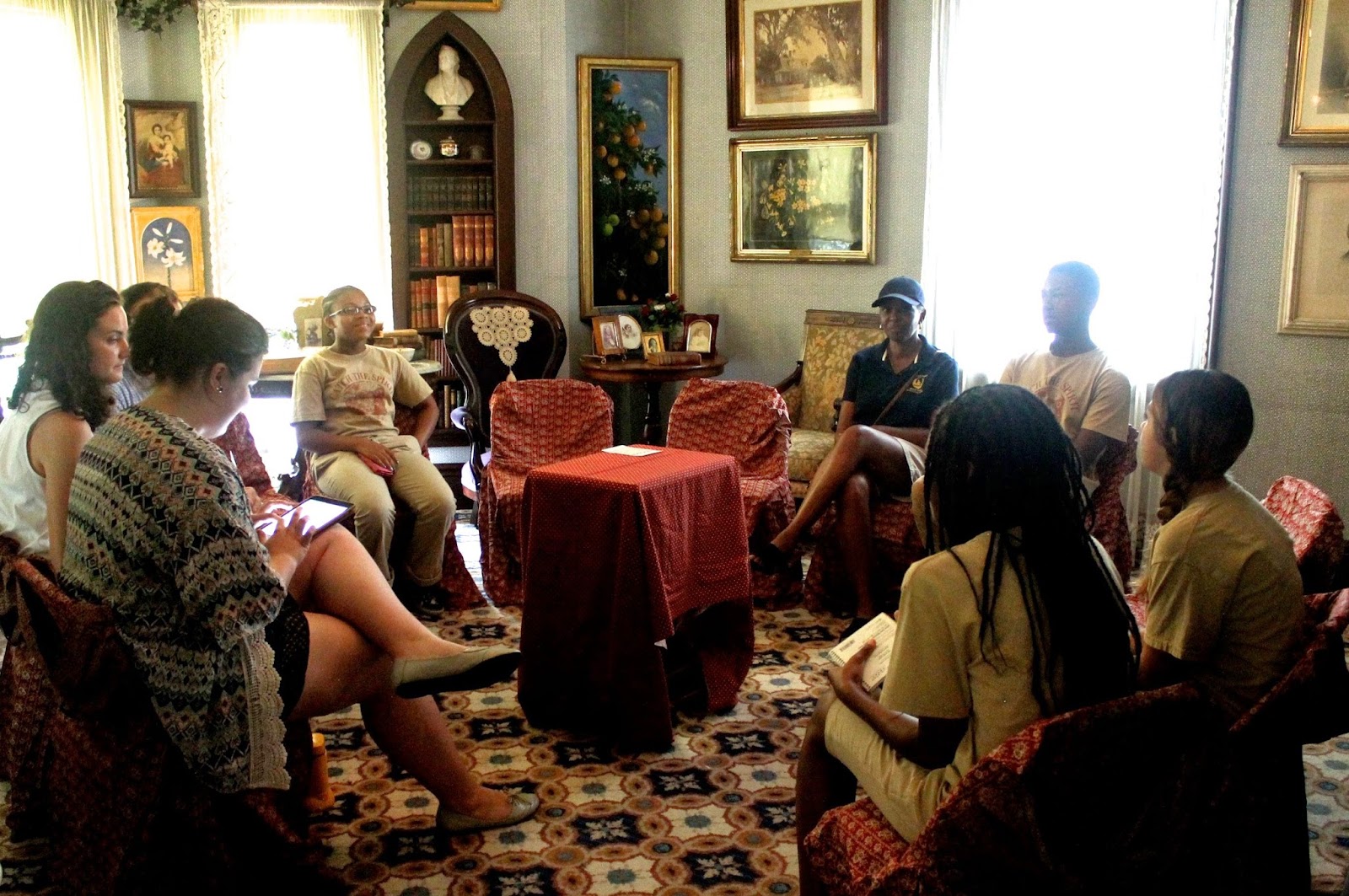
We decided to rethink four spaces in the house.  Two spaces in particular were both exciting and scary--the front parlor and the kitchen.  In our conversations with visitors, they had told us they really wanted to be able to sit in the house.  So that's what we did in both those spaces.  Stowe House is lucky to have a collections manager, Beth Burgess, who cares deeply for the collection and cares deeply about engaging audiences.  She's been a valued part of the team since the word go, and her willingness to move and remove objects in the service of interpretation has been so valuable.  So the period kitchen table was replaced with a reproduction, covered in brown paper.  Several chairs in the front parlor and the center table were relocated and replaced with folding chairs with fabric covers and a simple table on which there were reproductions of news articles and anti-slavery materials.  Total cost of all this?  Zero dollars.  Our overall goal was to more closely align the historic house experience with the Stowe Center's mission which includes:  promotes vibrant discussion of her life and work, and inspires commitment to social justice and positive change.  

The interpretive staff approached this with some pretty serious trepidation.  The education staff (big shout-outs to Shannon Burke and Brian Cofrancesco, my amazing partners in this entire process) and I decided that to start, one interpreter would lead the tour, except in the prototyping spaces, where I'd take the lead.  I'm very far from a Stowe expert, but I like a challenge, and I'm confident of my ability to encourage discussion.

What happened?  Over the next two days all of us were inspired and moved in so many unexpected ways.  It started with our very first group,  atypical for Stowe House, where most visitors, are like most historic house visitors, are white, female and over 65.  This group, just walk-in visitors, was a small group of African American and Latino local middle school students who give tours at a local cemetery as a summer job. When we got to the parlor, and sat down, I asked everyone to take a document to look at, and asked for a volunteer to read out loud.  One student read runaway slave ads and hesitated a bit, and then continued. Their adult group leader gently asked, "what were you thinking when you stopped reading?"  He looked up and said, "The ad said the slave was 5'11.  I'm 5'11.  It could have been me."   That stopped us in our tracks.  Just the act of reading out loud made something real and personal. We've found that reading aloud also worked for other types of visitors in different kinds of connecting ways--from parenthood to where you're from.
In the kitchen at the end of the tour, we'd designed the experience so that participants would have an informal chance to reflect on Stowe's commitment to social justice and connect it to the change they'd like to make in the world.  Sitting around a table covered in brown paper, encouraged to write and talk at the same time, meant that there was space for both.  Talkers talked, writers wrote, drawers drew,  thinkers thought and the table filled with thoughtful comments about the difference we can make in the world.

In just our brief experience, we discovered some really important things.

First, what we learned about the internal workings.  Although Shannon, Brian and I had these ideas in our heads, we really needed to show the interpretive staff the ideas in action.  And once we did, what had been some pretty substantial hesitation melted away.  Visitors loved the idea of participating in what seems like a behind-the-scenes process and that made interpreters feel comfortable with the experimentation.  The fear of change is powerful, and the simple prototyping was something that everyone could experiment with (it's an experiment!).  Seeing is believing.  And from our willingness to risk failure (that first tour easily could have gone not so well) and our willingness to learn from every visitor and every interpreter's experience, it's now become something that all of us are invested in. Wrote one staff member after giving her first prototype tour:
I was nervous at first, but as I talked, and as they participated I began to feel really excited and completely invigorated by what was happening.  My experience in giving the tour made me feel incredibly excited about what I was doing, and more importantly excited about giving a tour.   
We found a way to make everyone a part of the process.  The prototype tours always include an observer/notetaker and a simple form to collect information and observations from both staff and visitors about what works, what doesn't, and what we can continue to tweak.

And what did we learn about visitors?  They love experimentation.  They love dialog.  They love being fully in historic spaces. Stowe staff have been getting emails from visitors talking about their experiences (how often does that happen to you?)  Here's what one visitor wrote:
[The guide] advised us of some experimental procedures we would be involved in that were being tried out as part of the tour. The discussion group catalyzed by viewing media reproductions from the slave era was a terrific idea. After the normal hesitation to speak, our group was really starting to engage but had to break off in order to maintain schedule. My thought was, Is there some way to accommodate an extended discussion during or perhaps at the end of the tour? All in all a great experience.
And a big lesson?  Visitors are up for it all if it's framed and presented in ways that encourage--but not require--participation.  One of the documents we used in the front parlor were the words to the Abolitionist's Song, sung to the tune of Auld Lang Syne.  As we were wrapping up before my departure, we discussed the ongoing prototyping process, I said, "I bet you some group actually sings this in the tour"  Sure enough, Brian tells me that 3 or 4 groups have actually broken into song.    


We've got much more work to do, and many questions to answer and explore in the process of developing and refining the experience, but this speedy prototyping brought new energy and joy to our work.  Our cost?  Still pretty much zero dollars.

(and, in the shameless self-promotion category:  if you want to embark on rethinking your historic house interpretation, be in touch.  We can work together on a process that can create real change and meaning.)


Wednesday, April 30, 2014

Can You "Toyota" It? Lessons from the Factory Floor


One hallmark of a creative organization is the ability to look outside your usual realm.  Guest blogger Trevor Jones, Director of Collections and Exhibitions at the Kentucky Historical Society, shares his team's learning from the world of automotive manufacturing.  Read this, and consider where your team could go to learn something new:  a plant, a restaurant, a farm, or ?  It's probably right next door, wherever you are.

Have you ever worked on a project and noticed a problem but you were afraid to speak out? Perhaps you were junior team member, or the change would have been expensive, or the boss clearly didn’t want to hear about any flaws.  I’ve been there, and it stinks. Feeling unable to speak out leaves you frustrated and angry and also leaves the organization with a poor project. However, if you worked for Toyota, you would have been expected to speak out and propose a solution.

The Toyota plant in Georgetown, Kentucky is massive. They churn out 500,000 cars a year and you can tour the plant for free. The operation is a well-oiled machine where team members rotate jobs every few hours to avoid fatigue and boredom. As you move through the plant, a worker occasionally notices a problem and pulls a cord running above the production line. This action triggers a pleasant little song and the line stops. A team leader or supervisor runs over to address the issue and then the line starts again. The idea is that workers are expected to find small problems and fix them before they become big ones. Toyota’s entire corporate culture is built around the idea that quality is everyone’s job. Employees are not only encouraged to solve problems, but also discover ways to make the operation more efficient. If you work for Toyota and want to streamline a process, they’ll give you the time to build what they call a “cardboard and duct tape” version to see if it works. This is a low cost prototype to see if your idea actually has merit. The prototype is tested and evaluated, and if it’s successful it becomes standard practice and the person who generated the idea is rewarded with a cash bonus.
If you’re a management nerd like me you can read any of a dozen books about how Toyota developed this corporate culture and how other companies have tried to copy it. 


But, the real question is how does Toyota apply to the museum world?  The point is not to simply try to copy Toyota’s methods, but rather to use their culture as a springboard to get your staff to think about museum work in new ways. In their book Leadership Matters, Anne Ackerson and Joan Baldwin write that one of the dangerous myths of museum leadership is that “we are the source of our own best ideas.”  Looking outside our industry exposes us to new ways of thinking. My example is Toyota because they have a successful corporate culture and their plant is nearly in our backyard. A couple of years ago I convinced our leadership team to take the entire staff on plant tour so they could see the operation. This was followed by followed by lunch and a meeting with Toyota’s leadership to discuss their corporate culture. 

I’d studied Toyota, and my hope was their concept of “stopping the line” when a problem was spotted would become part of our museum’s culture. Our visit to the plant helped a little with that, but looking back at it a couple of years later, speaking up was not the concept that stuck. Instead, our employees latched onto Toyota’s concept of testing ideas with “cardboard and duct tape.” Our museum culture had been focused on producing polished “professional” products. As an accredited institution, the common belief was that we had to do things perfectly and that sharing something that looked unfinished or cheap was a professional affront.  We produced some really attractive things, but our culture created huge barriers to evaluation. Once you decide that a product is “perfect,” it becomes very hard to change it based on visitor feedback! Touring Toyota changed this view. We started doing “cardboard and duct tape” versions of exhibits and programs. We created draft labels and put them up with pushpins, and created freeform programs that could change easily based on visitor feedback. Our employees began using “Toyota” as a verb – when evaluating a proposal, people would say “That could be a good idea, but let’s Toyota it and see if it works.” 

As with cars, your mileage may vary, but looking outside your industry is a good place to find the catalyst to inspire your teams. Find a company that does something well, expose your staff to those ideas, encourage change and then reward the behaviors you want to see. Museums can rarely give out cash bonuses for good ideas like Toyota can, but we can single people out for praise, reward success with parties (our team likes cupcakes) and encourage people to constantly point out mistakes and suggest new ideas. It seems simple, but the folks at Toyota will tell you that there’s a lot of thought that goes into creating an organization where people feel that everyone has a responsibility to make things better. 


Images:  top, from Toyota.com;  center, temporary prototype labels courtesy of the Kentucky Historical Society, and bottom, Captain America cardboard template via therpf.com.  And just a note, you can't believe what googling cardboard and duct tape turns up!