Showing posts with label community empathy newfoundland inclusion. Show all posts

Sunday, September 25, 2016

Still Good? A Museum Re-Visit


Have you ever visited a museum again after a number of years, wondering if it will still be as interesting or exciting as you thought it once was? A couple weeks ago I had the chance to revisit Plimoth Plantation, somewhere I had last visited probably twenty years ago.  The memory of that long-ago visit was a lovely one, around Thanksgiving, with my big extended family.  Our kids, now all grown-up, fully engaged with the interpreters, and I still remember how the way one wowed my nephew, who described himself as living beyond the Hudson, by switching to speaking in Dutch.

Would it still be good?  Would there be interactive media everywhere?  Do people still suspend belief at a living history site?  What would I think?  Here's the good news:  I still found it compelling, and found some additional changes that deepened the experience even more.  The better news:  the things that matter are those that any organization can do.  Ask deep questions, seek answers, care about the visitors, and be unafraid to shake things up.

Some of what I saw:

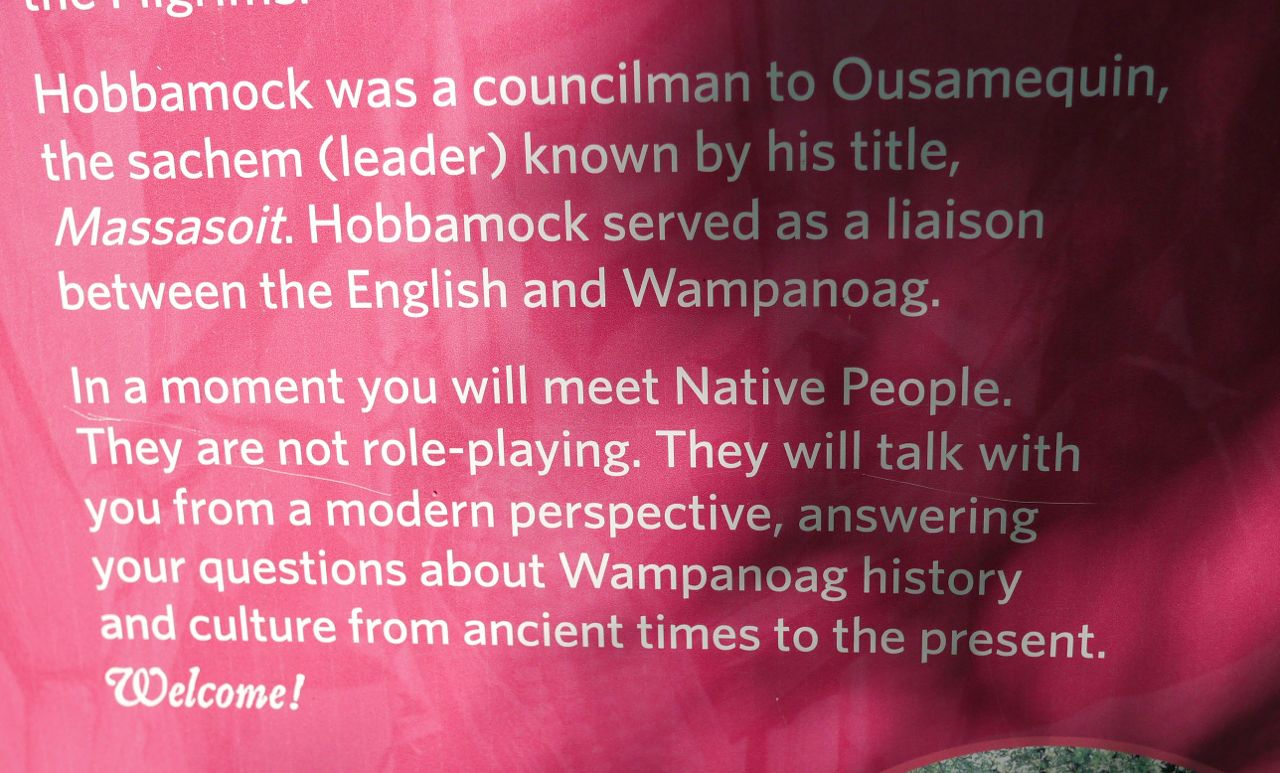
The biggest change is that your first stop in the 17th century is the Wampanoag village.  When I visited before, the village seemed an afterthought to all those Pilgrims.  Now Native people, rightly, are who you encounter first.  But you didn't encounter them without any guidance.  This large clear label, addressing directly, the misconceptions a visitor might have and what is considered respectful behavior, was read by almost everyone as they walked down the path.  The label begins, "Do you have a picture in mind from movies or books of what 'Indian' looks like?"   The change in approach--both physical and conceptual--helped to shift your perspective.


And something I saw over and over again, throughout the visit, was how skilled the interpreters were at meeting visitors where they were.  Here's a conversation about deer hunting, with a tourist from the midwest.  They chatted about bow hunting, about the return of deer to suburban neighborhoods, about recipes using venison, and more.


And here's an interpreter talking to students.  I only heard part of the conversation, when a boy asked if the interpreter gave someone a butt-whipping.  "I killed him,"  said the man, to somewhat stunned silences from the group.  He continued to explain and engage, but the sense that this was no easy place, came through loud and clear.  Below that, a visitor from the UK has a long conversation about where she's from, and where the character the interpreter is playing is from.  Just down the road, as it happens.


A question about a interpreter's bandaged finger, deftly handled, led to a broader discussion about the different kinds of religious beliefs at the Plantation, all the while the multi-tasking women continued their daily chores.


Every single interpreter I met, listened to, or eavesdropped on, was thoughtful, kind, and exceptionally responsive to visitors.  It's the end of the busy summer season and I'm sure loads of those questions (and bad visitor jokes) were ones they had heard many times before.  But they never seemed that way.  I want to know more about their training!


There were some new elements.  Down at the bottom of the road was "America's first test kitchen."  In a house no longer considered accurate, an uncostumed interpreter was testing recipes, on the day I visited, using quince.  The signage outside, her dress, and the printed-out recipe, all easily transitioned you back to a contemporary space and let you easily shift your conversational focus.  A new crafts building outside the village allowed close-up looks at the production of pottery, flies for fishing,  bread and textiles.


As you can see, it was a beautiful day with great light, so I was also struck with the messiness and everydayness of the site.  Reproductions allow the visitors to fully embrace the site:  to see the messy bed, the dirty fireplace, the wrinkled clothes hung up rather than the original draped artfully over the bed. There's no preciousness of artifacts here.


I ended my visit with a colonial meal--that's a peas cod (a sort of handpie),  squash, and some cucumber pickles and left feeling refreshed and rejuvenated in all sorts of ways, not least about the ways in which we can, when we work hard enough, connect with our visitors.


Monday, May 16, 2016

Should Museums Be More Like Constables?


I'm working on an exhibition for the Royal Newfoundland Constabulary Historical Society, in St. John's, NL.  I've been digging deep into their archives to learn more about the two hundred year history of the force, but a few weeks ago, I found some materials that I thought held some important lessons for museums.

I found a file containing a series of reports from 1948 from outport communities all over Newfoundland.  This was a critical time for what is now a province, because the vote about whether or not to become a part of Canada was drawing near.  It seems not far away, but as you'll see, it was still a time when those communities were often cut off by weather and bad roads.   These monthly reports were generally titled, "Economical and Social Life of the District,"  and were written by the local constable to be submitted to the chief constable in St. John's.

Here's a few excerpts:

In Corner Brook, in January, "the economical condition is quite good, and people in the main are employed gainfully and there is no report of able-bodied relief.  However, the herring fishery during the month is not nearly as good in previous years..."   and in February, the health of that community was "good during the month and there was no serious illness; there was however, a series of colds with no ill effects."

From Gander in February, "The Social aspect of the community remains more or less unchanged. However there has been some activity in connection with the various churches and the British Red Cross...the Gander Public Library is also filling an important position in the life of the community and is also increasing its services to the public..."

February was a quiet month in Ferryland, "There were no dances or parties of any kind held during the month" and the economy was bad, "Quite a number of men from Ferryland, Calvert and Cape Broyle are applying for relief."   In Trepassey, the weather was so bad that "the roof blew off Leonard Hachette's house and was beaten into matchwood."  As the bad weather continued there, "the men are complaining very much of having no food for their cattle.  There is no hay or oats anywhere in my territory as there is no boats running from here to town they cannot get food."

Spring finally comes that year, and the constable in Clark's Beach reports in April, "There have been no seals taken this month.  The people are all getting their fencing done for planting their vegetables...a card party and supper was held in the C.E. school at Salmon Cove and it was well-patronized by all."

Every month, the constables also took the political temperature of their towns around the issue of confederation or not, even though, said one,  "it's difficult to say."

What do I think museums can learn from these reports?

I can't tell you the number of times I've heard museum staff, board and volunteers say, "but no one comes, no one is interested."  That's because, I believe, you're not interested in them.  What would happen if you regularly spent time at a board or staff meeting talking about the social or economical conditions of your community?  Could you then learn about concerns--and equally importantly, learn about the parts of your community that you, as an organization don't connect with in any way?

I'm also struck by the empathy shown in these reports.  There's a real understanding of how and why relief is needed, of what benefits a community, and of the challenges and successes of community life.  That comes from attentiveness to the places we live--and all the people who live there too.  Our work can and should be a reciprocal process--that's how we can become essential parts of community life.


Images
Top:  Constables and community member, RNCHS collection
Bottom:  Adults in kitchen, Pools Island, Bonavista Bay, Gustav Anderson Photo Collection, The Rooms.


Thursday, April 28, 2016

Team Detective: What's Your Team's Spirit?


I'm an avid mystery reader, which I always thought of as leisure, unconnected to work.  But I've been thinking that there is a connection.  Part of any consultant's job is to go into a place and size up the situation quickly.  I'm not looking for footprints or the dog that didn't bark in the night, but I am looking for how a team works together.  I want to find the spirit of an organization as it looks to change in some way.  The changes might be big or small, but my work is almost always with organizations where change is in the wind--and change never happens with one person, it always happens with a team.

There's a great deal of research about teams:  you need introverts and extroverts,  you need leaders, it should be non-hierarchal and on and on.  Every team is different but here's my outsider's view on what helps a team move towards change.


Experimentation

As a consultant, I don't believe that I come with the answers.  I come with questions and the idea that together, we will puzzle out answers.  One way that happens is through experimentation.  Above, Matt Montgomery, Chief Marketing Officer at the Trustees,  becomes a docent as he leads us through a prototype of an Aeolian harp activity at the Old Manse in Concord.  And below,  Girl Scouts tag what matters to them at Juliette Gordon Low's Birthplace (she's the founder of Girl Scouts) in Savannah.  Experimentation accomplishes several things.  It builds team confidence together (and good humor) and it jump-starts a learning process.

Cast a wide net in your experimental process.  The tags are an inspiration from your friendly Museum Anarchist, and I'm definitely stealing Jeanne Vergeront's idea of a designated reader to share with colleagues.


Visitor and Community Centered

The strongest teams understand that interpretive change is not about protecting your turf.  They understand that museums and historic sites exist for community benefit.  Strong teams have a desire to understand their visitors and their communities.  They have empathy for different perspectives and are interested in learning what visitors have to say.  Last week at the Juliette Gordon Low Birthplace we asked scouts what they wanted to see or do, before their experience began.  "Be inspired!"  said several.  What a tremendous challenge those girls have set for us.


Trust and Fear

Below, staff from the Trustees trust that Matt and his group will not lead them astray in a prototype experience, as they are asked to close their eyes and listen.  Trust isn't always this literal, but change is scary, no question and the more teams can build trust together, the better.  At a mid-point in the interpretive planning process at the Harriet Beecher Stowe Center, we began one meeting by talking about our fears for the project. There were many as the change is big. They ranged from lack of funding to timeline to what would current visitors thinking.  Talking about all those fears somehow made them better.  The team had enough trust in each other to share them, and sharing didn't make them go away, but I think it did make them feel less of a burden and we've continued to be attentive to them as interpretive planning moved forward. 


Everybody has a Voice and Everybody Listens

Last week, sitting in Lisa Junkin Lopez's sunlit office in Savannah, I worked with a team who, I think, felt all their voices mattered.  Ideas tumbled out, they built upon one another.  On my second day there, I was stopped in the hall by the head of maintenance, who had been off the day before. She'd read this blog and we had a great conversation about sounds, listening and meaning-making. Ideas come from everywhere, so it's important to create an environment where everyone feels that their contribution can build something stronger.  

This also means understanding differences of all types on a team, and listening to and respecting those differences.

But What About Dysfunctional Teams?

I'd love to say that every client is a dream team, but unfortunately not. Here's a couple things I've observed that will slow down your team's ability to cope with change.
  • Body language:  arms crossed, eye rolling, unwillingness to participate in small group activities.  We all should know better.
  • "We already do that, we've already done that, that will never work."  No need to say more.  That never moves anything forward.
  • Unclear decision-making process.  That's frustrating for everyone, and that's a place where a leader needs to lead.
  • Perfectionism.  It sounds trite, but perfect is the enemy of good.  We work in places with so many variables, including our many visitors.  We need to do our best, but honestly, we cannot perfect visitor experiences for every visitor because every visitor brings so much to the visit.
How's your team culture?  (and, in a brief commercial, if you want to talk interpretive change at your organization, be in touch!)


Wednesday, April 6, 2016

What's the Opposite of Fear?


For some reason, I've been thinking a lot about fear lately.  It's definitely in the news, of course.  I've been in the Brussels subway and on the streets of Paris;  I've been saddened by the ways in which our current politicians seem to play on this country's deepest fears.  People ask me fairly often if I'm afraid to travel to European countries, or to a place where a war is happening, like Ukraine.

But I also feel and hear fear in my work.  I hear from colleagues who are afraid that others in their organizations will not embrace change;  from people who fear change; from those who are afraid of failure in attempting to be more inclusive; or those who are just afraid of being inclusive. Fear of surrounding authority still resounds loudly for many.  Some parts of one generation of colleagues fears technology or irrelevance; another generation fears that first generation will never retire; and yet another fears finding meaningful work.  And of course, there are loads of things I'm afraid of too.

It's really easy to think that the opposite of fear is courage.  That's a big thing, and many of us, like the Cowardly Lion, think it's too big to tackle.  But I think the opposite of fear might be curiosity or empathy or some combination thereof.  There's no question that curiosity is a driver in my work and travel.  I'm curious about new places, about people different than me, about new food, about the way museums work in different settings.  But that curiosity isn't quite enough.


Empathy is a word that seems overused these days, but I still think it might be the right way to push that fear away.  A couple weeks ago, I was in my favorite bakery in St. John's, Newfoundland, Canada and this poster was up.  I didn't take a great photo, but in case you can't read it, it says,
They are coming to meet you.  Find out about their past struggles as new Canadians, and their future endeavors...
Think about the fear that these families have had, to come from their homes far away, to Canada. Think about the fear you would feel in the same situation.  Empathy, that sense of understanding another--for people different than us, whether it be our colleagues, our community members, or people we will never meet, is what can make the fear melt away and lead us to action.  Any museum (and there are a growing number of models to draw from) can learn those stories, provide support, and build bridges.  It doesn't matter what your focus or your location is.

I'd been thinking about fear, trying to puzzle out what I was really trying to understand when this came across my Facebook feed yesterday.  It's the video from Robert F. Kennedy's speech in Indianapolis the night Martin Luther King was shot and killed.


Watch it.  Think about the fear that night that so many people had, Kennedy included.  Think about the way he expresses empathy and makes a choice to share his own pain and sorrow as a way of connecting; think about how deeply human a speech it is.  (to say nothing of the fact that I can't imagine any politician today being able to quote Aeschylus and then to say,
What we need in the United States is not division; what we need in the United States is not hatred; what we need in the United States is not violence and lawlessness, but is love, and wisdom, and compassion toward one another, and a feeling of justice toward those who still suffer within our country, whether they be white or whether they be black.
We talk about the need for museums to be relevant, but several times this winter, I had the chance to be in places with Sarah Pharoan, of the International Coalition of Historic Sites of Conscience, who spoke movingly about the need for museums move beyond relevance to become essential. That's something that will only happen if each one of us steps past our fears and puts our curiosity and our empathy to work.

(and, by the way,  I'll still be traveling and hope you will too)