Showing posts with label authenticity. Show all posts

Wednesday, November 30, 2016

What Next? A Month of Reflection


Like millions of Americans, the last month has been a confusing one for me. I returned home from Ukraine just two days before the election, proudly voted for Hilary Clinton (I just learned that a niece of mine wore different pieces of jewelry representing her grandmothers and great-grandmothers to go vote that day, in their honor) and drove to Mystic, CT for the New England Museum Association conference. Jetlagged, I went to bed early and woke up at 4:30 AM to learn that Trump had won the election.

Since then, I’ve been trying to figure out my country and its citizens, trying to determine what I personally need to do next, wondering about museums’ place in this world, and trying to listen and read as much as I can (though I have stayed away from TV news). I don’t have any answers yet but I wanted to share some ideas that have resonated with me.  It's a long post, bear with me.

Museums Can Be Essential

First, that very first morning at NEMA, I went to a session presented by Sarah Pharaon of the International Coalition of Sites of Conscience. It seemed very much the right thing to do that morning; and in fact it was. She reminded us of the power of history and of the important way that museums can move from relevance to essential parts of communities and the larger world.

Support and Action

I made a quick trip up to the Concord Museum mid-conference for the opening meeting for the development of plans for a new permanent exhibition there. Our conversations about the American Revolution and Henry David Thoreau were all shaped by the week’s events. But I’ll remember most what one of the museum educators said over coffee. She had decided on two things: support and action. This meant financial support for Planned Parenthood, an organization she supported; and action, starting to volunteer at a local organization working with refugees. That two-part approach made a great deal of sense to me.

Serious Play

Rainey Tisdale and I facilitated a session at NEMA about museums and your whole self: not just your learning self, but your spiritual self, your playful self, your civic self; and more. We were going to use the election as a starting point for our activity but it seemed just wrong, just too much at the end of a challenging week. Instead, our lively group of participants got to think about whole self museum development within the framework of kittens (and thanks, Rainey, for convincing me to do that!) Somehow that goofy exercise lifted all our spirits. We’re all going to need to be attentive to serious play as we move forward.

Be More Attentive to My Own--and Others-- Privilege 

I’m white, I went to an Ivy League college and have a Master’s degree. I teach. I’m older than many of you readers. I’m female. I have lots of privilege. I’ve vowed to be more attentive to instances where I need to check that privilege, and to call out others on the same. This also means figuring out how to be the best ally I can. For me, that’s not a safety pin, but there are certainly other times and places, in my work and outside of work,  that I can listen, speak out, and work to make a difference.

Read More

I came across an NPR piece that suggested we all needed to expand our reading—to learn about people different than ourselves. I’ve put several books on my Goodreads list (if you want, please feel free to connect with me there) and if you’re looking, check out the New York Times 100 Notable Books of the Year and the Guardian’s pieces in which authors chose their favorite books of the year. I admired my colleagues who managed to get thoughtful blog posts up over the last month, considering the role museums may play in building a more civil, civic society. In particular, I found these useful and thoughtful:

Center for the Future of Museums, “Healing the Partisan Divide”
Rebecca Herz, Museum Questions, “How Do Museums Create a Better World?”
Paul Orselli, Exhibitricks, “Are Trump Voters Museum Goers?”
Koven Smith, “Better Ways to Win: MCN 2016 and the Presidential Election"

Talk More, Listen Even More

The next week, I attended MuseumNext, which I found in different parts, fascinating and infuriating. First, the infuriating part: I’m stunned that, as a field, we consider a groundbreaking conference one where people read prepared remarks from behind a podium, with barely time for a question or two at the end. We know that’s not not how people learn. Everyone I spoke with at breaks felt frustrated. There was a strong sense that we were talking to the choir and more than a bit of discussion that seemed to frame things in terms of us and them. Although I live in a blue state, I live in a very red part of it. I think the us and them is unproductive at best. There were speakers that inspired me, and I’ll hopefully write more soon about them.

Advice from the 20th Century

I’ve had emails and Facebook comments and condolences from colleagues all over the world. This election was a big deal to everyone and uncertainty looms large, whether it’s how Trump’s relationship to Putin will affect Ukraine, how his business dealings will affect Turkey, how his approach to the world will affect the Baltics, or almost anywhere else in the world.

A Ukrainian friend posted a link to Yale historian Timothy Snyder’s Facebook post, now appearing in other places as well. I greatly admire his book Bloodlands for its deep understanding of the history of Ukraine and its neighbors; and he continues to be an active, thoughtful commentator on Ukraine and that part of the world.

He shared 20 lessons from the 20th century. I won’t share them all (you can find them in full here) but here’s a few that particularly struck me.
  • Defend an institution. Follow the courts or the media, or a court or a newspaper. Do not speak of "our institutions" unless you are making them yours by acting on their behalf. Institutions don't protect themselves. They go down like dominoes unless each is defended from the beginning. 
  • Be kind to our language. Avoid pronouncing the phrases everyone else does. Think up your own way of speaking, even if only to convey that thing you think everyone is saying. (Don't use the internet before bed. Charge your gadgets away from your bedroom, and read.) What to read? Perhaps "The Power of the Powerless" by Václav Havel, 1984 by George Orwell, The Captive Mind by Czesław Milosz, The Rebel by Albert Camus, The Origins of Totalitarianism by Hannah Arendt, or Nothing is True and Everything is Possible by Peter Pomerantsev. 
  • Stand out. Someone has to. It is easy, in words and deeds, to follow along. It can feel strange to do or say something different. But without that unease, there is no freedom. And the moment you set an example, the spell of the status quo is broken, and others will follow. 
  • Make eye contact and small talk. This is not just polite. It is a way to stay in touch with your surroundings, break down unnecessary social barriers, and come to understand whom you should and should not trust. If we enter a culture of denunciation, you will want to know the psychological landscape of your daily life.
  • Learn from others in other countries. Keep up your friendships abroad, or make new friends abroad. The present difficulties here are an element of a general trend. And no country is going to find a solution by itself. Make sure you and your family have passports. 
  • Be a patriot. The incoming president is not. Set a good example of what America means for the generations to come. They will need it.
But interestingly, I found one good example for future generations coming from a member of a generation too young to even have a classification. Riding the New York City subway one day, I sat down across from a little girl with a big rolled-up sign. I asked if she had made it, and could I see it? She shyly assented, and unrolled it (she's at the head of this post). I asked if she’d been out protesting. Yes, she said, and her mom and sister nodded as well. (and the mom said it was okay to take her picture). This tiny citizen, with her big sign, lifted up everyone on that train. We smiled at her and each other, spoke to each other for a minute, and I somehow felt that perhaps, we were all in this together, in a way that mattered.

Museum people, we have work to do.

Thursday, October 6, 2016

Mythbusters: Pilgrim Edition


Virtually every American knows a Pilgrim myth or two.  It's the kind of thing many of us learn at every Thanksgiving dinner and with every hand-made paper turkey on a school classroom window. I'll have to admit, that when I visited the Pilgrim Hall Museum in Plymouth, MA, I expected more of the same.  The museum opened in 1824 and describes itself as "America's museum of Pilgrim possessions."  But, I was walking by, and decided to visit--and was incredibly surprised at the smart, thoughtful exhibit that deconstructed--that busted those myths--about Pilgrims.


A few examples:   the opening label talks about the Pilgrim story, but doesn't quite give the full hint that some myths are about to be busted.  The mythbusting took two prevalent forms.  First, deconstructing what we believe (and the stories that museums have often told) about objects.  For instance, the spinning wheel above, and label below, which says, "in fact, no spinning wheels recorded in the Colony until the late 1630s."  (no sheep, either).


And here's another one, about a sword. When was the last time you read a label that said, "This is not possible."


The exhibit included reproduction clothing, showing how our ideas about Pilgrims were reflected in the clothes worn and depicted, in films, paintings, and even in museums.  Below, a label from one interpretive era, and clothing from another.


With some objects and images, the labels cleverly paired the mythmaking (Longfellow, you have much to answer for) with quotations from historic documents.


The romance of laughter and tremulous voices, compared with death and eleven children.  This painting of Thanksgiving gets these contrasting labels.


Note the inclusion of the contemporary voice of Linda Coombs, a member of the Wampanoag nation, on the label, contrasting directly with Sarah Josepha Hale's 19th century voice.

It's the rare museum that takes on busting up its own history.  Consider your own history museum. What stories could benefit from some revision?  Can you do some rethinking that lets your audience into the messy nature of history?  How about a new take on those cows in your community?

Sunday, September 25, 2016

Still Good? A Museum Re-Visit


Have you ever visited a museum again after a number of years, wondering if it will still be as interesting or exciting as you thought it once was? A couple weeks ago I had the chance to revisit Plimoth Plantation, somewhere I had last visited probably twenty years ago.  The memory of that long-ago visit was a lovely one, around Thanksgiving, with my big extended family.  Our kids, now all grown-up, fully engaged with the interpreters, and I still remember how the way one wowed my nephew, who described himself as living beyond the Hudson, by switching to speaking in Dutch.

Would it still be good?  Would there be interactive media everywhere?  Do people still suspend belief at a living history site?  What would I think?  Here's the good news:  I still found it compelling, and found some additional changes that deepened the experience even more.  The better news:  the things that matter are those that any organization can do.  Ask deep questions, seek answers, care about the visitors, and be unafraid to shake things up.

Some of what I saw:

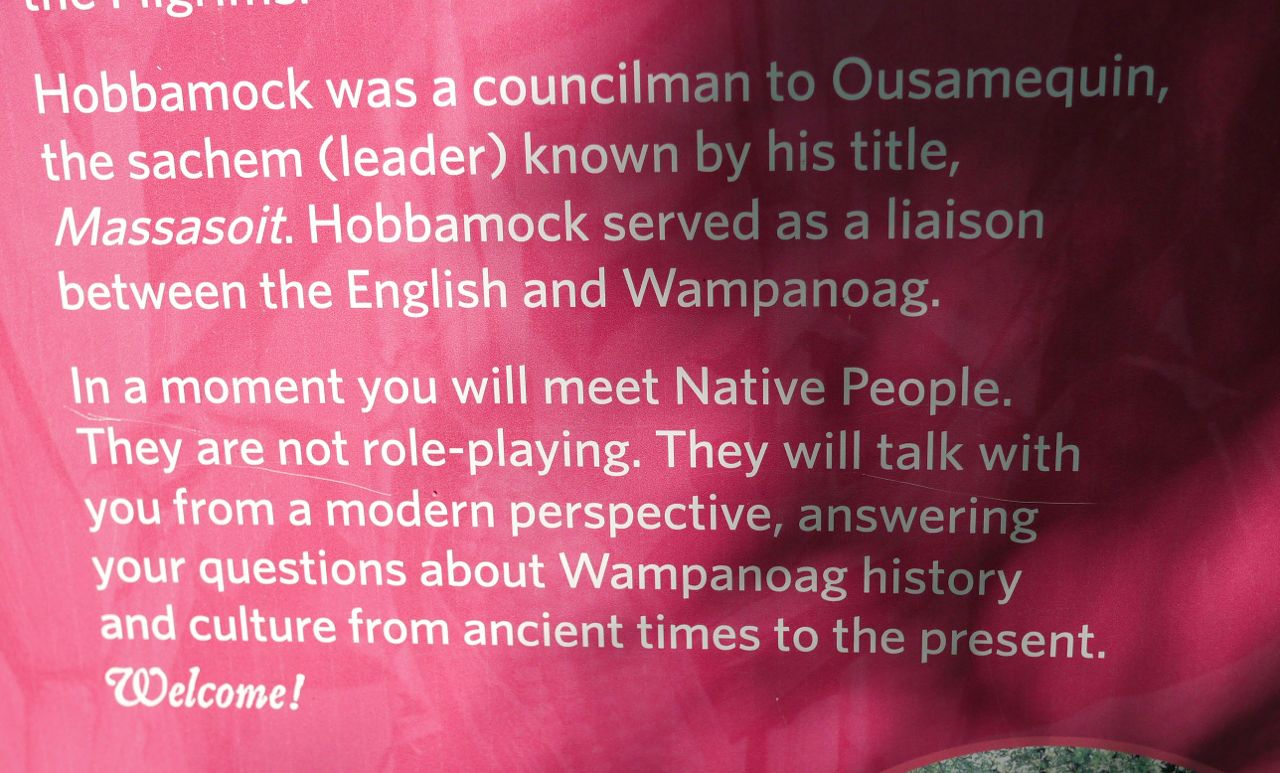
The biggest change is that your first stop in the 17th century is the Wampanoag village.  When I visited before, the village seemed an afterthought to all those Pilgrims.  Now Native people, rightly, are who you encounter first.  But you didn't encounter them without any guidance.  This large clear label, addressing directly, the misconceptions a visitor might have and what is considered respectful behavior, was read by almost everyone as they walked down the path.  The label begins, "Do you have a picture in mind from movies or books of what 'Indian' looks like?"   The change in approach--both physical and conceptual--helped to shift your perspective.


And something I saw over and over again, throughout the visit, was how skilled the interpreters were at meeting visitors where they were.  Here's a conversation about deer hunting, with a tourist from the midwest.  They chatted about bow hunting, about the return of deer to suburban neighborhoods, about recipes using venison, and more.


And here's an interpreter talking to students.  I only heard part of the conversation, when a boy asked if the interpreter gave someone a butt-whipping.  "I killed him,"  said the man, to somewhat stunned silences from the group.  He continued to explain and engage, but the sense that this was no easy place, came through loud and clear.  Below that, a visitor from the UK has a long conversation about where she's from, and where the character the interpreter is playing is from.  Just down the road, as it happens.


A question about a interpreter's bandaged finger, deftly handled, led to a broader discussion about the different kinds of religious beliefs at the Plantation, all the while the multi-tasking women continued their daily chores.


Every single interpreter I met, listened to, or eavesdropped on, was thoughtful, kind, and exceptionally responsive to visitors.  It's the end of the busy summer season and I'm sure loads of those questions (and bad visitor jokes) were ones they had heard many times before.  But they never seemed that way.  I want to know more about their training!


There were some new elements.  Down at the bottom of the road was "America's first test kitchen."  In a house no longer considered accurate, an uncostumed interpreter was testing recipes, on the day I visited, using quince.  The signage outside, her dress, and the printed-out recipe, all easily transitioned you back to a contemporary space and let you easily shift your conversational focus.  A new crafts building outside the village allowed close-up looks at the production of pottery, flies for fishing,  bread and textiles.


As you can see, it was a beautiful day with great light, so I was also struck with the messiness and everydayness of the site.  Reproductions allow the visitors to fully embrace the site:  to see the messy bed, the dirty fireplace, the wrinkled clothes hung up rather than the original draped artfully over the bed. There's no preciousness of artifacts here.


I ended my visit with a colonial meal--that's a peas cod (a sort of handpie),  squash, and some cucumber pickles and left feeling refreshed and rejuvenated in all sorts of ways, not least about the ways in which we can, when we work hard enough, connect with our visitors.


Monday, January 4, 2016

Surprise! Looking Back at 2015

Like most bloggers, I spent the last few weeks contemplating my year-end post. So much time, in fact, that the year ended! I was lucky enough to ring in the new with Drew, Anna and thousands of Romans and visitors to Rome overlooking the Coliseum. But now, time for some reflection. I visit lots of museums, so many in fact that I keep track on a google map (2014 and 2015 combined). I realized that the one thing I wanted most in a museum or historic site visit was to be surprised. So here, in roughly chronological order, are the museums, exhibits and historic places that surprised me or made me feel a sense of joy and importance in our work. I've written about some of these, but others are thought of and shared often in person but I just didn't find the time to write about.

Sherlock Holmes at the Museum of London
One of the smartest, most clever exhibits I'd seen in a long time, as befits the master detective. I loved the way historic objects and images were used to tell the story of Holmes in London. The place became real, but so did those 19th shoes used to explain Holmes' observation skills, and of course, that blue coat worn by Benedict Cumberbatch.

Dennis Severs House, London
Like magic. Entering at night, by candlelight, visiting in silence, voices rustle away as you enter a room. What is going on in this 18th century house? It was thrilling to see a historic house as an artistic creation by a single individual, with the ability to transport us to a different time with no more bells and whistles than candlelight, a room in disarray and a subtle sound track.


The Battlefields of the First World War, France
I would not have believed you if you told me one of my memorable historic site visits this year would be a visit to battlefields, on a chartered bus guided tour with college students, but it was. Why? First, a good, lively guide, with good knowledge and ability to judge his audience. Second, the people I was with. Watching students take in the enormity and waste of war in direct ways. Third, the physical places themselves. To walk in a trench now softened and green, to see a bomb crater, to read the names and names and names at a memorial. And lastly, to have a bit of meaning-making come full circle. We stopped at the Beaumont-Hamel Memorial, commemorating the first day of the Battle of the Somme when an entire Newfoundland regiment was virtually wiped out. The centennial is approaching and there are many commemorative efforts underway in Newfoundland. This summer, at a small outport town. I happened to have a conversation about visiting there. "You did?" said an older man, "my father lost an arm there." All of a sudden that battle was even more real, echoing down the years.

Museum Karel Zeman Prague
"Why do I make movies? I'm looking for terra incognita, a land on which no filmmaker has yet set foot, a planet where no director has planted his flag of conquest, a world that exists only in fairy tales." Karel Zeman

Pure joy. Just steps away from the Charles Bridge, the museum focuses on the work of pioneering Czech animator Karel Zeman. Using the hand-drawn early 20th century animations as a design starting point, combined with hands-on activities that explain the special effects, this museum turned our group of serious adults into a group deep into serious play. A perfect match of creative content, design and interpretation.


Context Travel Walks in Berlin, Prague and Budapest
Context Travel has been a great client for three years now and as result I've been on a number of their scholar-led small group deep dives into art and history. With them I've learned about art in the Vatican, Revolutionary Paris, the Golden Age of Amsterdam and even the food of Istanbul. But this year, four walks in these three Central European cities really stood out for me. The walks were on Jewish history and the Berlin Wall in Berlin, and the Communist era in both Budapest and Prague for three main reasons: a strong sense of place, even when some of the elements of a particular place had vanished. As I stood at the Memorial to the Murdered Jews of Europe in Berlin, a great docent helped us understand that the site had once been surrounded by the buildings in which the bureaucratic apparatus of Fascism functioned as a killing machine. Two, a sense of real people's history.

It was on the same walk that I first encountered artist Gunter Demnig's Stolpersteins, or stumbling blocks. The size of a cobblestone, these brass plaques are installed in front of the former homes of Nazi victims with just a simple name and date. You can now find them in many European cities-I saw them most recently in Rome last week.

But the most important factor in making these walks memorable were the docents' own stories. It always a fine line to work between over sharing and just right, but I'll long remember the story of one docent's brother participating in the 1968 protests, another sharing his story of being brought up in West Berlin when it seemed the height of teenage rebellion to go piss on the wall after a night of drinking. In Budapest, our docent, raised in Romania, helped us compare personal lives under regimes.


National Art Museum, Kyiv, Ukraine
Two exceptionally smart exhibits here last spring demonstrated the value of deep thinking about museum collections and the history of how museums have thought about the objects they hold. Heroes looked at art in the museum collection categorized as "hero" from Lenin to poets to heroic workers while another exhibit examined those works that had been blacklisted by various regimes and the roles (sometimes heroic and sometimes not) that museum staff played in categorizing and sometimes safeguarding such works. We have much to learn from examining our own histories. The museum's innovative director, Maria Zhadorzha, departed at the end of 2015; I only hope the Ukrainian Ministry of Culture has the initiative to name an equally talented director to lead the museum's exceptional team.

The Exploratorium, San Francisco and The Oakland Museum, Oakland
Paired together for two reasons: one, the same trip west, but two, places whose reputation precedes them. It's great to see that places you read about live up to their reputations. Great experiences both places but at the Exploratorium the surprises were how welcoming the exhibits were to adult experimentation and play and how they're expanding beyond the physical sciences to take on more complicated topics. In Oakland, the talk-back labels were genius, and visiting on a Friday community night showed that museums can attract broad segments of visitors, if they really make an effort.

The New Founde Land pageant, Trinity, Newfoundland
This seemed possibly hokey to me, and parts of it were. But the other hand, a musical theater production that moves the audience from place to place within a historic village while providing us all with a bit of Newfoundland's complicated history, proved unexpectedly moving.


Scandale:  Vice, Crime and Morality, 1940-1960,  at the Montreal History Center
This shouldn't have been a surprise to me because the exhibit Scandale was curated by one of my 2014 mentees, Catherine Charlebois, and our conversations that year often ranged widely over the issues of developing creative exhibitions. The exhibit uses oral histories as a framework, installed in all sorts of ways: a nightclub tables, in mug shots, at a card game. There were not many objects in the exhibit so, purposefully so, the oral histories and photographs do the storytelling work. Most surprising: walking in a recreation of a prostitute's room and seeing a downward video projection of a couple on the bed!

Lessons Learned
The lessons for me in all these surprises? Experimentation, a sense of humor, a deep commitment to place, and most of all, the sense in exhibit and historic site interpretation that our complicated human natures can make almost every story compelling and moving. I'm grateful to my clients, old and new, who embrace our creative process together.

What will surprise me in 2016? I've already got a few museum visits already completed this year and it's only the first week of January, so I know there will be surprises coming. In your work, consider making a resolution that surprise and joy are a part of your next project. Surprise me! What could you do differently?

(And please forgive the somewhat wonky posting and formatting. There's a learning curve on my new iPad!)

Monday, December 21, 2015

What Would You Do?


In this post I'm joined by Aleia Brown, reflecting on our joint NEMA session building on #museumsrespondtoFerguson. The session, including all the conversations leading up to and following, were an amazing opportunity to work with a thoughtful, reflective and passionate colleague whose work I had followed. Thank you Aleia!  And of course, please continue to check out the #museumsrespondtoFerguson monthly twitter chats.  Here's the latest Storify.
  • A volunteer at your museum says, “Those kids in this neighborhood, they come in and I know they’re going to steal something, so I keep a really close eye on them.” You’re the volunteer coordinator. What do you do?
  • You are in charge of an annual event and one of your regular vendors shows up selling the Confederate flag. What do you do when you’re a junior staff member?
  • You have photographs of your historic house museum in 1930, including an Aunt Jemima cookie jar in the kitchen. Do you recreate it exactly?
At the New England Museum Association conference, we co-facilitated the session, #MuseumsrespondtoFerguson: Bringing Race Into the Foreground. Our goal for the session was to open up in-person conversations that provide all of us with tools for moving beyond conversation to real change.

How did the session work?
Behind our conversations, we ran a rotating Powerpoint of historic and contemporary images about race and racism in New England. From the Amistad to Henry Louis Gates’ arrest on his front porch, there was much to show. We really wanted conversation and so we began by each sharing, from our own perspectives, experiences with race in a museum. And then we asked participants to share a situation, any situation, where you felt powerful, a time when you felt uncomfortable or out of place. and then a time in a museum, or anywhere else, that you found yourself in a racially charged situation--or an uncomfortable situation.

The questions above are just a sample of the ones we distributed to small groups for conversation, and then circled back to large group discussion. And we got discussion! So much so that almost half an hour after the session ended, folks were still sitting around talking and the hotel staff asked us to leave so they could set up for lunch (see above).


We’ve now had the chance of a month or so of reflection, and wanted to share some of our own learning.

The conversation needs to start now. One participant noted that she felt uncomfortable with having this conversation in a room of mostly white people. We agree that a more diverse group of participants would be great, but we also strongly believe that if we wait for the museum field to be more inclusive to have the conversation, it’s simply too late. Begin now. You can find all our conversation starters here, to begin.


Niceness is overrated.  Many of the thoughts shared by participants showed more of a concern for niceness, and a lack of willingness to rock the boat in any given situation. Nice is overrated. We also encouraged participants to think about who benefited from niceness. Rather than challenging racist remarks, niceness effectively ends the conversation. Niceness is often another form of complicity.

Internal conversations are the hardest.  When we did a debrief together, a week or so after, we both noticed that groups did not volunteer to share certain conversation starters. Some of those conversation starters were the ones that addressed staff dynamics. Ones like:
  • A person of color raises a concern about race in a staff meeting. What do you do if you’re the director? If you’re a peer? If you’re a subordinate?
  • Your museum’s education and outreach department consistently prioritizes white museum studies graduates over African Americans with deep community roots and experiences. What do you do?
  • Your museum’s security staff is African American and the rest of the staff is white. Each group eats lunch in a separate space. What do you do?
We wished we had recognized this in the moment, and encouraged sharing of perspectives. These are tough issues, not involving visitors in the abstract (if there is such a thing) but the people we work with and see every day. 


Get Out There A participant commented that it was difficult to get new groups of people into the museum. Linda was pretty vehement in her response--get out there! The days, if there ever were any, of expecting people to come just because you invite them are over. You--you personally, your museum--you--need to go to community places and meet community leaders in their own places, not in your own, safe to you, place.

Linda: At the end of the session, after some conversation about the risks of speaking out, Aleia spoke passionately from her own perspective about the risks that she takes: that speaking in front of a group of white museum professionals about racism is a risk; that co-leading the #museumsrespondtoFerguson tweet chats is a risk; that writing about the Confederate flag is a risk. She encouraged us all to think about the risks that people take every day to make the world different and to get out of our own, risk-averse heads and step forward.  I'll long remember this.

Aleia: I left the session with so many thoughts swirling through my head, but I will just share a few. First, I want to continue to encourage museum professionals to use specific language. In the session, and in other spaces, I often heard phrases like, “we don’t talk about it.” What is it? Racism, anti-blackness, prejudice, white supremacy…? I don’t think we can expect to solve our race-related issues in the field, if we can’t identify and verbalize them.

Second, I hope museum professionals understand that these sessions are not just mental exercises. Racism, in and outside of the field, is a real thing that has real effects on real people. I always wonder if I effectively communicate the urgency to understand racism as something concrete that negatively impacts every aspect of our society rather than abstract. Thinking about social justice is not enough. We have to act in ways that are timely, and beneficial to people of color- who the field has marginalized for so long.

Finally, our session was one part of our journey toward a field that values race equity and social justice. As Linda mentioned earlier, I always look to other risk takers for encouragement and motivation. Shortly after our session Mizzou students gained attention by risking their bodies, their scholarships and much more for race equity. Their actions should embolden us to not only discuss race, but to also take actions to make our field an inclusive and equitable space.


Be the Change
We asked participants to write postcards to themselves, with 30 day resolutions about addressing racism in museums. Some were personal, some were institutional, some were specific and some were general. But all of them were worth attending to. We’ve mailed them out, but we've shared a few in this post. What change will you be making?  


Sunday, January 3, 2010

Harder to Do--Guided Tour or Exhibit?


While in the Lake District, we visited Dove Cottage and the Wordsworth Museum in Grasmere. Dove Cottage, Wordsworth's home during a productive eight-year period is one of the Lake District's most loved attractions and opened to the public in 1890. The accompanying Museum and Art Gallery was relocated into its current space in 1981. This is an organization with a long, rich history and rich and varied collections relating to Wordsworth and the history of Romanticism.

So why was the museum exhibit so well done and the house tour so boring?


Wordsworth--so what do most people know?  Poet, daffodils, Lake District (I mean you are at his house),  British.  That's probably about it.   Me too.  We visited the exhibit before the house tour, although it appeared that most people went after the tour, but the timed tours led us to head to the museum first.  

What did the exhibit do right?


  • It used the facts, objects and places of Wordsworth's life in combination with his poetry in ways that let the visitor see and understand how he found inspiration in his own life and the world around him.

  • The audio installations were very simple--just a printed version of a poem (here's Tintern Abbey) and headphones.  It was really nice both to see the text and to hear the words spoken aloud,  reinforcing the beauty of both the spoken and written word.
  • The use of contemporary photos helped to reinforce the sense that the landscape Wordsworth knew and loved is still the one that can be seen today in the Lake District.
  • It allowed me to gain not only a sense of the man and his work--but a bit of unexpected knowledge.  Who knew that his wife had written about those daffodils before he did?
What did the guided tour do wrong?   Pretty much everything.
  • Barely welcomed by the guide, the tour began with the history of the house--the group of about 10 or so, including children, were given no sense of who Wordsworth was, or why he mattered.
  • A host of irrelevant and confusing facts:  I didn't particularly care that branches were used as toothbrushes, and cared even less about Mrs. Wordsworth's false teeth.
  • Quite surprising handling of original objects from the guide.  Although we were cautioned about touching anything, the guide touched and opened a number of objects used by Wordsworth.
  • Small displays of objects in each room in tiny cases that looked like they dated from the house's opening as a museum.  Locks of hair, candlesticks, and more.  They had a fun, antiquarian feel, but did little to drive the story forward.
  • Not a single place where the guide asked us if we had any questions. Not one!  And even more surprisingly, at the end of the tour, upstairs, he said, "okay, well, I'll just leave you to look around,"  and went downstairs, leaving us free to roam among several rooms.   


Now why would the exhibit (and a changing exhibit as well) be well-done and engaging while a guided tour was anything but?  A few purely speculative guesses:
  • Exhibits often have a clear planning process, with a beginning and an end.   They present, in effect, a blank slate that can be shaped, through both curatorial and design work, into a compelling narrative.
  • Historic houses are accretions.  In my own work, I've found it rare that a historic site is willing to step all the way back and take a comprehensive look at the interpretation.  So a house becomes a bit like sedimentary rock--each layer and each bit of knowledge hardened into the present day.
  • Personal connections make a huge difference.  If the guide had appeared even a bit interested in his audience, I might have felt differently.  If he had made any effort to engage the young children on the tour I might have forgiven other weaknesses.  I can only hope that it was the end of the season and he'll spend the winter recharging his batteries or that all guides undergo some sort of regular evaluation.
  • Historic houses, more than exhibits,  contain memories of how it used to be.   "But the trunk has always been on the bed,"  I can hear someone saying, whether it ever made sense or not.   There's a fear, I think, of change that doesn't exist for exhibitions.


If you work at a historic site, take a moment and reflect on the last time you really thought about that guided tour or the way things are shown in the house.  Consider how to take a long step backwards to get a clear view of how a visitor might perceive the house.   Your visitors will thank you for it.

Saturday, January 2, 2010

Be Careful What You Wish For


Last week, we spent three days in the Lake District in Great Britain. It's been a tourist area for more than 200 years. In 1844 William Wordsworth campaigned against a proposed railway saying that to make the region accessible would ruin its scenic beauty. During our cold, snowy (but sunny!) days there, we found the region incredibly beautiful. The Lake District National Park clearly works incredibly hard to maintain the region's identity. Villages and small towns maintain much of their character in the centres (most designated as Conservation Areas), working farms still spot the landscape (though many also operate as B and B's), and clearly development is restricted along the lakes themselves.


But...8.3 million visitors a year come to the region--89% by private car. And it's not a big national park from an American perspective: only 34 miles wide. In comparison, the much larger Yellowstone National Park gets just over 3 million visitors a year. Our B and B host told us that in the summer she rarely even goes out on the roads--too crowded. She and her family are some of the only 42,000 or so people who live in the District full-time. It was easy to imagine bumper-to-bumper traffic on these tiny roads and lanes during the summer months. Even between Christmas and New Year's, the streets were crowded with walkers (usually in full gear) heading out to the hills.


It's the eternal dilemma isn't it? We want people to visit our museums, our historic sites, our no-longer industrial communities--but success brings more challenges than we imagine. As I checked out the Lake District National Park website, several things struck me as they dealt with the challenges of success. First, that information--public hearings, downloadable documents, up-to-date and clear web info--is key in making both residents and visitors partners in the process of preserving and appreciating this unique place. In the planning section of the website there's even a section called, "Unraveling the jargon." Third, the park, a governmental agency, clearly understands that it's work won't be possible without multiple, committed, community partners. Third, it's planning that makes the difference. The park has a clearly articulated vision for the next twenty years and a downloadable plan for how it will be achieved.

Vision:

"Working together for a prosperous economy, vibrant communities and world class visitor experiences - and all sustaining the spectacular landscape."

The Lake District National Park will be an inspirational example of sustainable development in action.

A place where its prosperous economy, world class visitor experiences and vibrant communities come together to sustain the spectacular landscape, its wildlife and cultural heritage.

Local people, visitors, and the many organisations working in the National Park or have a contribution to make to it, must be united in achieving this.

What will it actually look like in 2030?

A prosperous economy - Businesses will locate in the National Park because they value the quality of opportunity, environment and lifestyle it offers - many will draw on a strong connection to the landscape. Entrepreneurial spirit will be nurtured across all sectors and traditional industries maintained to ensure a diverse economy.

World class visitor experiences - High quality and unique experiences for visitors within a stunning and globally significant landscape. Experiences that compete with the best in the international market.

Vibrant communities - People successfully living, working and relaxing within upland, valley and lakeside places where distinctive local character is maintained and celebrated.

A spectacular landscape - A landscape which provides an irreplaceable source of inspiration, whose benefits to people and wildlife are valued and improved. A landscape whose natural and cultural resources are assets to be managed and used wisely for future generations.

Could I see this as a visitor? Actually, yes, in many ways. Our B and B served eggs and bacon from a family farm; local products are found throughout the stores (we brought home great looking mugs from Herdy); brochures encourage you to "give the driver a break," by taking buses, trains, or boats; and the landscape is spectacular and at the same time, lived-in and homey.

Plans aren't worth anything unless they're put to work--and have community buy-in. I want to try and keep an eye on the Lake District as the region's plans move forward. What will it be like in 2030? I hope there will still be a chance to be a solitary walker (or three of us) going down a country lane to be met by a flock of Herdwick sheep.