Showing posts with label museum. Show all posts

Sunday, November 1, 2026

I'm Getting to It!

I've seen a number of wonderful exhibits here in Latvia, and I want to share them with you--but I've been slow getting to it. It's terrific that that my delay, reading British mysteries, going to markets, and more, is actually the theme of a fabulous exhibition at the Latvian National Museum of Literature and Music.  Literature and music occupy a vital place in Latvian culture--for everyone, as I've discoverd. The permanent exhibit is Procrastination and Creation.   The visitor begins with a manifesto (when was the last time you saw one of these to start an exhibit!).


I love that this manifesto is written as "We,"  putting us in the same place as these revered artists who are often only seen on a pedestal.  In our work on creativity, Rainey Tisdale and I found this procrastination phase vital, although we didn't call it that (hello, incubation time).  Each artist gets their own vignette, an installation that includes both original objects but also sometimes video and hands-on activities.  Each one is witty and engaging.


Director Iveta Ruskule taking a sniff of something that I can't remember what!


I particularly loved that the exhibit's designer even created a display of her own creative space in an upstairs hallway, showing her own process.  But the best part, the very best part, was that each artist's ways of procrastinating were highlighted!


Here are some lessons I took away:
  • Re-invention is always possible!  The museum is 100 years old and took the chance to do something totally new.
  • "Surrender the chronology!"  Long-ago, in a planning meeting, a renowned historian advised this--and it really worked here.  The simplest choice would have been a chronological presentation--simple but boring!
  • Have fun!  It must have been great to work through all these procrastination labels.  They are funny and moving, and of course, we can all see ourselves in them.
  • Mix it up!  Audio, video, hands-ons, photos, objects, created spaces, many from natural materials were all used in ways that didn't interfere with each other.
Such a pleasure!  As an additional note, virtually every exhibit I've seen here in Riga has beautifully translated English language labels that are much appreciated!

Wednesday, September 16, 2026

Why Latvia?


I'm almost two weeks in to my four+ month time as a Fulbright Scholar in Riga, Latvia and I am hoping to return to regular blogging to share what I'm learning and experiencing here.  So I thought I might begin with a bit about Riga and Latvia.  Latvia is one of the three Baltic countries (along with Estonia and Lithuania) on the Baltic Sea--it's pretty far north!  It's not very big--about half the size of New York State--and is fairly flat, and deeply forested.  The country has a long and complex history--centuries of German, Swedish, Polish-Lithuanian and Russian rule.  It was established as an independent republic in 1918, but then of course, the 20th century brought occupation by both the Nazis and the Soviet Union (the latter which lasted 45 years).  The country became once again, an independent republic in 1991.  Latvia's a part of the EU and NATO and support for Ukraine is notable here seen both in blue and yellow flags everywhere, but also in conversation.


Riga celebrated its 825th birthday this past August and the city itself reflects all those centuries!  Remember the Hanseatic League from Western Civ classes?  Riga was a part of this trading network.  You can see medieval architecture in the old town, some of the most spectacular Art Nouveau buildings anywhere,  wooden clapboard buildings interspersed among 19th and 20th century architecture, including some Soviet blocs and the zeppelin hangars turned Central Market, and newer architecture including the mountainous National Library.  


The museum, cultural heritage and contemporary art community is vibrant, with all sorts of activities that I'll be exploring. I've already been out to the contemporary craft fair at the Ethnographic Museum and visited the Natural History Museum to see the community's display of dahlias.  


But it's complicated, of course, which is what I want to learn more about here. My interest in this part of the world goes back a long way--I'm fascinated by the way places make and remake themselves physical, emotionally and societally.  I've been lucky enough to get to know some Latvian colleagues through ICOM and the wonderful Baltic Museology School--that helped my decision to apply for a Fulbright here.  Big questions to consider:  How does 20th century history affect lives today?  How should museums address that history?  What does it mean to be Latvian or a Latvian citizen?  How can cultural organizations help build civic participation and identity?  What sorts of intangible heritage help shape that identity?  All of these questions are complicated by the residents who are non-citizens, who colonized Latvia from other Soviet republics (see label from Museum of the Occupation above.) Needless to say, the war in Ukraine has deepened concerns around Russia in every way.  Elections are in October, and I don't understand yet all the issues, but see big wall posters around the city for different parties.

Also on the learning plan?  Finding the best coffee and pastry place in the city!  Stay tuned.

Friday, May 9, 2025

Brave Museums Part 3: The Legacy Museum


As I get back to regular blogging, I want to begin each one, when I can, calling out museums that are brave in challenging times.  Today, check out this New York Times article featuring a number of sites and museums dedicated to telling the full story of American life, including the story of African Americans and the legacies of enslavement.  In the article, Ashley Rogers, director of Whitney Plantation, reminds readers, “a wound doesn’t get better if you ignore it. It just festers.”

This week, thousands of museum folks are gathering for the American Alliance of Museums annual conference in Los Angeles where I'm sure so many issues about history, funding, and more will be discussed.  I miss Twitter for conference sessions and hope someone will find Threads or some other way to share for those of us not there.  Please share other brave museums you learn about!

But, on to another brave museum.  Some museums become brave, like the Valentine that I wrote about last time (and as an aside, some start as brave and become less so). But others are born brave--their very founding is a call for us to remember and to be brave about facing both past and future.  A few weeks ago I spent a day at the Legacy Museum and the National Memorial for Peace and Justice in Montgomery, Alabama.  Created by Bryan Stevenson and the Equal Justice Initiative, a non-profit law office. The goals and inspiration of the Legacy Project are described on their website: "Seeing firsthand how excessive punishment, racial discrimination, and inequality are deeply rooted in America’s history of racial injustice inspired us to create the Legacy Sites. By offering these unique spaces for people to gather, learn, and reflect on our history and its legacy, we hope to foster a new era of truth and justice in America."

No pictures are allowed in the museum and I didn't take notes, partly because of the nonstop conversations Dina Bailey and I were having along the way.  As a result, I have no pictures of label texts, so this post is more reflective of the experience overall.  As you enter, you encounter a very large video of waves, crashing forward, which served to me as both a representation of the journey of the middle passage and of the journey the exhibition would take us through.  The museum has almost no objects and in the early history,  stays away, for the most part, from the images that are so familiar.  Instead, there were hand-drawn videos (with the hands shown at work) sharing parts of the story and as well, concepts and historical facts that may be unfamiliar to many.  We didn't take time to watch the installations in the small theater spaces, but I can imagine they are equally powerful.

The label text is unsparing--when is the last time you saw the phrase "racial terrorism,"  to describe our history?  The amount of graphics with words:  runaway slave ads, legal notices, newspaper headlines, all in black and white, feels a bit overwhelming.  As we read the labels though, it struck us that this is very much an exhibit developed by folks with legal minds.  They assemble the evidence--so much evidence--and then make an impassioned argument.  The exhibit demands our attention to the evidence.

Photo:  EJI

There's also a subtle shift in perspective.  Earlier in the exhibition,  you walk on the outside of cells where you can hear re-created audio of enslaved African Americans--but you're on the outside, listening in, still at some remove.  But at the end of the exhibition, visitors can sit and listen, face-to-face with death row inmates, making sure that visitors understand that this is not history, that this is not past, and that the legacy of enslavement and racism continues forward.

Photo:  EJI

But then,  at the end of the exhibition, we entered a space that I found so beautiful and moving.  It's a very large gallery, that is floor-to-ceiling portrait images, faces only of African Americans of achievement in every field.  The space is copper/gold colored and is the place where the importance of Black imagination, passion and knowledge are made gloriously clear.  We sat in this space for quite a while, talking, but also watching people as they walked through, stopping at images they recognized or sitting like us, for a moment to take it all in.  


From there, we went to what's commonly known as the Lynching Memorial (also, by the way, the admission cost for all three legacy sites was $5 and the tickets are good forever if you don't make it to all three in a day).   There's been a great deal written about this memorial (for instance, here, here and here) and I hope all of you who can will make your way to Montgomery.  As we approached the memorial, there's a large, pristine green lawn between us and the memorial itself.  As we wound our way up the path, the large iron shapes, each delineating a county and its lynchings, come closer and closer.  And then, all of a sudden, we found ourselves looking at counties and wondering.  Wondering about the people named, wondering about all of the unknowns, wondering about why the lynchings happened when they did--sometimes a county had quite a few in a year, and then none.  We walked among these pillars, slowly making our way down the ramp until these are hanging over us, as lynching victims would have been.  You could feel the deep pressure and pain.

I particularly appreciated the way this national memorial focused on the local.  By creating this county-by-county memorial, it makes it hyper-local.  Visitors, including us, think about counties we know, or have been to.  But it also, after the memorial, let's us know that we can make change.  All of the county pillars have duplicates, lined up on the ground for counties to take home once some sort of reconciliation process has taken place.  There are still lots of them left--but then, down a bit, are versions of familiar shaped historic markers for those counties who have actually done the work, a clear message that there is much work still to be done.


"Hopelessness is the enemy of Justice."    
~ Bryan Stevenson

(thanks Paul Orselli of Exhibit Tricks for pointing me to this interview and quote that I found 
when I was writing this post)

Sunday, April 20, 2025

Brave Museums Part 2: The Valentine


Before I talk about a brave museum I've visited, I wanted to shout out all those brave museum colleagues in the United States (and librarians too!) who have pushed back against the current administration's executive orders.  In particular, check out, if you haven't already:

and of course, so many others of you--keep it up!

The Valentine Museum is in Richmond, Virginia, once the capital of the Confederacy.  It was founded in the late 19th century and its first president was sculptor Edward Valentine whose studio was relocated to the museum grounds.  Pretty straightforward, right?

Not to the talented folks who took on the task of rethinking Valentine's work, including co-curators Christina Vida and Josh Epperson. Valentine was perhaps the best-known sculptor of Confederate memorials.  An exhibit, opened in 2024, seeks to understand, not the work, but what it stood for, why it was created, and most importantly, what legacies it has left us today, to still grapple with.  The museum describes it as an "exhibition that examines how the Lost Cause myth was spread through centers of power, like media, education, politics, money, religion, and violence."   

Interestingly, like the museum I wrote about last time, there's lots of text.  Both museums seem to believe deeply that visitors are up for challenging topics, which often need lots of text. No dumbing down here!  A thoughtful three-year process involved surveys, focus groups, conversations and programming.  This serves as a reminder to all of us--it's not the length of the text, it's the quality of ideas and language.  This exhibit used tough questions to bring folks into the topic (and effective, clear yet compelling design).  For instance,


You're involved in the label conversation, you're not just a passive consumer.  They want you to consider past and present in a city where the past and present are inextricably intertwined.  Valentine's sculptures are still on show, but behind a scrim, with the sense that they are ever-present, yet perhaps receding in a city where the White House of the Confederacy is just down the street.

I've been lucky enough to work with the team twice on developing dialogic approaches for working with groups, both adults and young people as part of my role at the International Coalition of Sites of Conscience.  This is a challenging exhibition and the team has been dedicated to dialogue,  really embracing it as a tool for individual and collective learning.  Below, two pictures from a 2024 workshop and an image sharing what the group was proud of, one year later.


Two other notes on this museum:  first, there is an extensive list of resources on their website, including lesson plans for students. Second, in its permanent exhibit, the Valentine shows the statue of Jefferson Davis, covered in paint, and lain on its side. Visitors can post comments next to the statue which does inspire some strong reactions.  According to the staff, the museum's director, Bill Martin, is always willing to come down and speak with visitors about the statue, the exhibit, or anything else on their minds.   A willingness to engage with difficult issues, to work with communities to understand complex histories, to stand our ground and not obey in advance, is needed now more than ever.  Thanks to all of you who do.

Thursday, January 5, 2023

My Top Museum/Heritage Experiences of 2022


2022 meant back to travel, which meant that I got to meet incredible people and see incredible places in person.  Here, in no particular order are some experiences that surprised, inspired and moved me.  But the most important is the final one, so please read on!


Difficult stories in Czechia

Last spring, I spent an incredible week out and about in the Czech Republic, in three very different locations, presenting workshops on telling difficult stories.  Stepan Cernousek and Petra Černoušková of Gulag.cz, joined by interpretation specialists Kristýna Pinkrová and Ladislav Ptáček identified three places with challenging histories.  The five of us loaded into a van and set off.  The plan for the week was to arrive at a place, give me a chance to learn about it, by meeting with local historians and others, and then do a workshop the following day.  From socialist industrial history to the oft-ignored history and persecution of the Roma people, to the Sudentenland, I learned so much and understood more about how past shapes the present. The workshops were wonderful, but what I remember more are the conversations--over breakfast, over dinner, and in the van, up and down roads across the country with four amazing folks, willing to answer all my questions, and help me ponder my own work and how we can make a difference.  Here's some reflections from the team.


Mammoth Dialogues in Texas

When the Waco Mammoth National Monument in Texas requested dialogue training from our team at Sites of Conscience, I really wondered how in the world I could train in dialogue around mammoths!  I didn't know anything about mammoths, and to be honest, not much about Texas.  But, off I went.  The great team at the site, including some really thoughtful interns, had backgrounds very different than mine--archaeologists and paleontologists mostly.  But, at the end of several days, the group, working together, had found so many interesting and important dialogues to consider using with their visitors.  Climate change--fossils help us understand that.  Evolution--absolutely.  How do we value and understand science and expertise?  Absolutely again.  I appreciated the willingness of this team to embrace new ways of working as they helped me learn too.


In Conversation with Clint Smith 

I first learned about Clint Smith when my husband said, "I just listened to this guy on Fresh Air that I think you'd really be interested in. I then devoured his book, How the Word Is Passed: A Reckoning with the History of Slavery Across America, recommending it to everyone I knew. As you can imagine, I was thrilled and honored when Amy Hufnagel from the Harriet Beecher Stowe Center asked me to be in conversation with Clint as a part of their Stowe Prize ceremony. which recognizes a distinguished book of general adult fiction or non-fiction that illuminates a critical social justice issue in contemporary society in the United States. In the book, he shares his visits to historic sites and the related conversations with visitors and staff, and his own reflections on those experiences, from Confederate graveyards to Monticello.

“Across the United States, and abroad, there are places whose histories are inextricably tied to the story of human bondage. Many of these places directly confront and reflect on their relationship to that history; many of these places do not. But in order for our country to collectively move forward, it is not enough to have a patchwork of places that are honest about this history while being surrounded by other spaces that undermine it. It must be a collective endeavor to learn and confront the story of slavery and how it has shaped the world we live in today.”

In a wide-ranging conversation, we talked about when he first knew he could be a writer (a third-grade poem), how history interpreters can be leaders in the needed conversations in this country, and how he views his work--and our work--as something that is not done for our generation, but for the generations to come. You can watch the full conversation here.


The Tenement Museum in New York City

In October, I joined my Sites of Conscience colleagues on a visit to the Tenement Museum.  97 Orchard Street, the tenement itself, is temporarily closed, but we saw an exhibition/installation about garment workers that I had not seen.  But my big takeaway here was not interpretation (though it was great), it was about what visionaries can accomplish.  Ruth Abram, the founder of the Tenement Museum was also the founder of the International Coalition of Sites of Conscience.  In a 2014 interview, she spoke about a key question for her work:

"Most of my life there's been a single question hanging over each thing I've done, whether in the women's movement or the civil rights movement, and it's how are we going to be one nation and at the same time appreciate, enjoy, and not be afraid of the sometimes profound differences we bring to the table based on our backgrounds?"

This was not, of course, what historic houses were doing in 1992. But over the last decades, the worldwide museum field (including the new definition) has moved closer to Abram's vision of museums and historic sites as places where we can "appreciate, enjoy and not be afraid."


Hadrian's Wall, United Kingdom

On a glorious November day, historian Joanne Sayner and her family took me off on a walk to the highest point of Hadrian's wall in the north of England. What made this memorable? It was a reminder of how large the Roman Empire was (just a month earlier I had been looking at Roman walls in the subway station in Sofia, Bulgaria). But it also was a chance to consider history outdoors, to see not only the wall, but also the varied landscape, altered over centuries. It was a reminder that joy and history can find places to work together. (a shout-out also to the very nice interpretive center, with its dialogic questions in an exhibit!)


Ukrainian Museum Colleagues

Here's the most important museum/heritage experience of 2022. As most readers know, I have a long deep experience in Ukraine, beginning as a Fulbright Scholar fourteen years ago this month. Until the pandemic, I had been able to return almost every year for one project or another, and have had the opportunity to travel all over the country, doing workshops, meeting colleagues, and learning a great deal. I have not been able to visit this year, of course, but I am in awe of the work that Ukrainian museum workers have done, showing courage and resilience under circumstances that few of us can even imagine. They have packed collections away, they have repaired damaged buildings, they have continued to do programming, in courtyards or subway stations underground, they have supported their colleagues in more dire need, they have shared their work to the world, working to decolonize narratives, they have asked for accountability from our international organizations. All this while they are working to keep themselves and their families safe. They are true heroes.  At the ICOM meeting in Prague, I had the chance to catch up with some Ukrainians in person (above, here we are at lunch) so this photo stands in for the thousands of colleagues doing challenging, difficult, meaningful work.

I want to encourage those of you who are able to contribute to supporting Ukrainian museums and museum colleagues. These are two locally-organized endeavors doing great work in Ukraine:

What did I Learn this Year?

As I look back and reflect on these experiences (and many more) there are a few important takeaways for me.

First, curiosity. I want to learn about places, about people, about the past, about where to eat the best local food (fabulous barbeque outside Waco!), the best beer (okay, all over Czechia), what different building styles mean and so much more. Accompanying curiosity is a willingness to ask questions and to acknowledge what it is that you don't know. I don't necessarily think of myself as a humble person, but it's true, curiosity is a kind of humbleness.

Second, believe that change is possible. From Ruth Abram's vision to Clint Smith's hope for the future, from tough conversations in rural Czechia to the work of Ukrainian colleagues--they all demonstrate that change is possible, but it requires not just hope, but also work.

Third, it's people that matter to me. It's not only objects or buildings that created the memories, although they are a part of all these experiences. It's the chance to have conversations--in a van heading across Czechia, under a big tent with Clint Smith, and even on Zoom calls with colleagues (though thankfully fewer of those these days!). A particular shout-out to the best work conversation person for me, Braden Paynter. We laugh that we start from two different ends (he's theory, I'm practice) to get to some really interesting conversations about ways to approach our work, almost always meeting in the middle! I've learned about the value of silence from him, and he's learned, I think, about the value of jumping in from me. A lucky, deeply meaningful work pairing.

An informal fourth: try to eat local food wherever you are! Check out the end of the post for some of what I ate this year from Texas barbeque to Italian gelato to Czech dumplings to a giant Scottish breakfast.  If you're interested in general travel plus photos, in addition to museums, follow me on Instagram

And what else?
So many other experiences this year--too many to write about, so my intention for 2023 is to do more writing, more immediately, about what I see and learn. Deep appreciation to all those of you who I met along the way. Stay tuned for 2023. 


Sunday, October 23, 2022

Exhibition Layers: Small but Mighty in Prague


I've spent more hours than I could possibly imagine working on how to tell complex stories in exhibitions:  how to layer a story,  how to draw people in, how to include multiple perspectives, and most of all, how to make it something where people want to look, to read text labels, and something where visitors walk away talking about it.  As those of you who also do this work know, it's really hard!

So when I see an exhibit that really is layered, that really draws people in, and is the first exhibit produced by an organization, I really want to share it.

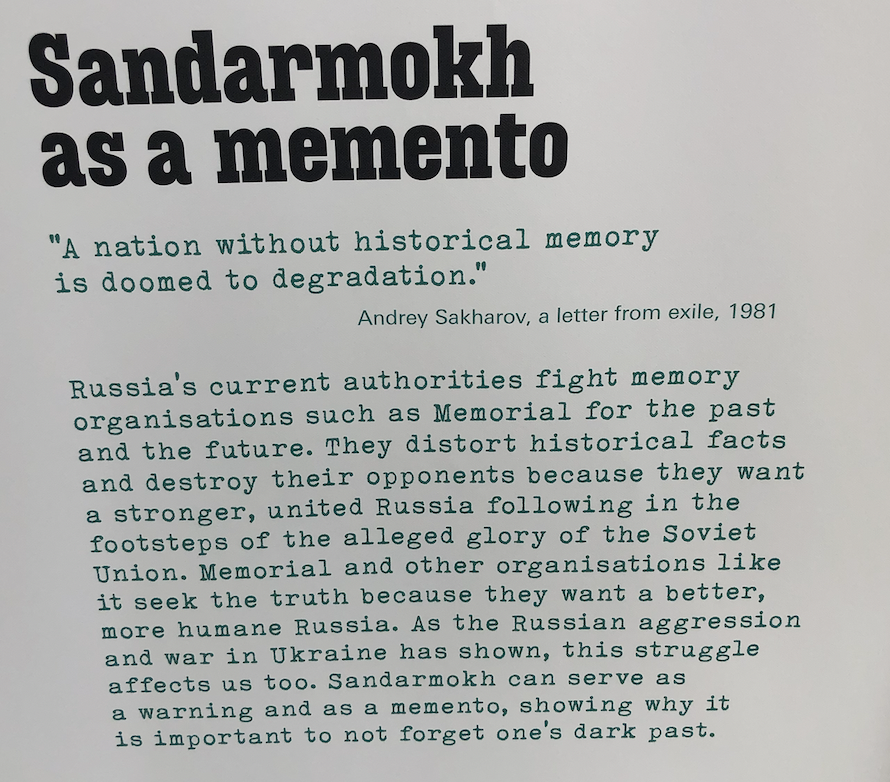
This summer in Prague, I had a chance to see the exhibit "Sandarmokh – Where the Trees Have Faces"  produced by Gulag.cz, an organization dedicated to documenting gulag sites of the former Soviet Union (and elsewhere).  Gulag.cz was also the sponsor of a series of workshops I did in the Czech Republic this spring--their work is tremendous on many levels.  

What were the layers?  First, the exhibit is the story of Sandermokh,  "a distant place in Russia’s Karelia, close to the Finnish border, and the scene of a massacre that was meant to be forgotten. As the Stalin repressions peaked in 1937–1938, more than 6,000 people of 56 nationalities were executed there. In addition to many Russians, Karelians, Finns, Ukrainians and the members of other European and Soviet nationalities."  

Second, it's the story of historian Yuri Dmitriev from the Memorial association in Russia. Dmitriev and colleagues from the St. Petersburg Memorial office located Sandarmokh precisely in 1997, and they found and documented the names of the majority of those executed in the years that followed.  But the official attitude of this work has changed greatly over the decades.  Dmitriev was unjustly arrested, tried three times, and finally sentenced by the Russian Federation's Supreme Court.  He is now serving a sentence of 15 years in a Russian penal colony.

The third part of the story is that of Memorial International, a co-winner of this year's Nobel Peace Prize but also an organization that Russia considers a direct threat and which has faced repeated challenges to its work in Russia and has been disbanded there (though it continues its work elsewhere).

And the final part of the story: Gulag.cz issued an open call for art relating to the topic.  More than seventy artists responded with an astonishing variety of work.  When I saw the exhibit in Prague, just a few of the works were on exhibition, with others to be shown at each location. Once the tour is completed, the works will be auctioned off to benefit humanitarian aid to Ukraine.


What made all these stories, all these layers, work together in a small-scale panel exhibition when we often see layering attempts in big, expensive exhibits that fail?  Here's the elements that I thin made it work.

People-centered.  This exhibit is about people, about Yuri Dmitriev and his work, about others at Memorial, about those killed in the forest, and the artist statements give us an entirely other group of people to consider.  No matter where you are in the exhibit, people are at the center.  The goal of Stalin was to eliminate people and in every way, this exhibit reinforces that these people, and these stories matter.  It's particularly relevant as Stalin's tools are returning every day in Ukraine.

Different ways of learning.  You can look at the artwork--some of it easily accessible and some of it more challenging.  You can read the labels.  You can look at a recreation of Yuri's desk.  You can look at historic photos of those who were killed and more recent, yet historic photos of memorial ceremonies at the site.

Really well-written labels.   I was lucky enough to visit the exhibit with Stepan Cernousek and Petra Černoušková of Gulag.cz.  When I mentioned how well-written--brief and compelling--the labels were, Stepan laughed and said, "oh, that was all Kristýna!  She kept telling us that we had to use less text!"  A big shout-out to Kristýna Pinkrová, a tremendous museum colleague who I also got to know this spring.

Simple, low-budget design.   The exhibit is traveling, so the design needed to be affordable and adaptable to many different spaces. It was a modern, window-filled space in Prague and it looks like a vaulted brick-ceiling space in Brno.  But the design works both places.

And lastly, and perhaps most importantly, tell stories that matter.  There are important, vital stories to tell in every community, no matter where you are in the world.  You don't need to do another display of wedding dresses or the chronological history of your town. If you don't think those stories exist, you aren't listening. 

At the Prague opening, Dmitriev himself was able to speak by phone from the penal colony where he is currently unjustly incarcerated and delivered the following thoughts:

"I immensely appreciate your hard work which you do to preserve the memory. However, I think we've done less than we could. At least, those who were engaged in the preservation of memory in the Soviet Union and in Russia. Maybe that's why we live in such difficult times now. Complicated and tragic times. Nevertheless, I don't think we should give up for we must continue to deal with what we have dealt with, to talk about what has happened and what is happening now. For there is a direct connection between the past and the present. That's probably all I wanted to say to everyone here. Good luck.“

These are my own photos--you can see many more, and much better ones on Gulag.cz's site.  Many, many thanks to Stepan, Petra, Kristýna, and all those who worked on the exhibition.  I am so proud to know you and inspired by your work!