A special shout-out to colleagues at all these places--and all the other places I visited this year-- who have created bits of magic and deep meaning from the raw materials of buildings, objects, and most importantly, human stories.

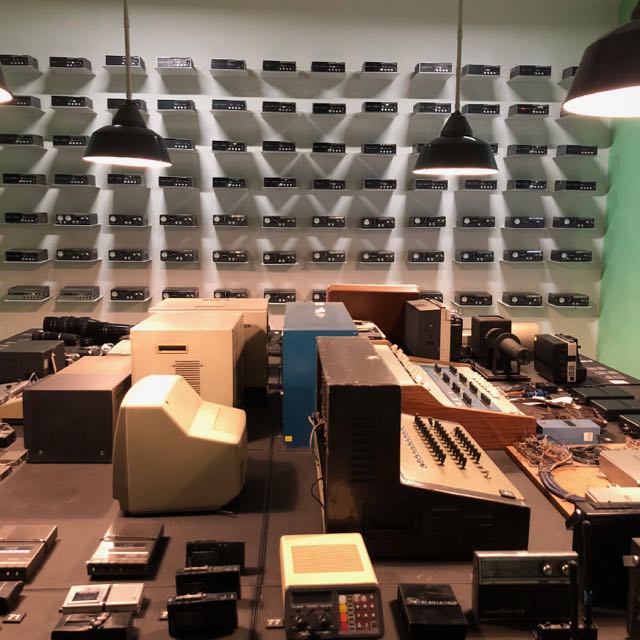
House of Leaves, Tirana, Albania
In my work these days, I visit many museums and memorial sites that tell the story of repressive regimes--but this place really surprised me. It told the story of only one part of Albania's past, sharing the details of the surveillance of virtually every part of Albanian society. It raised questions about victims and perpetrators. about pride in work even when it's repressive, about the ways in which societies come to terms (or not) with the past. All of these complicated questions revealed in imaginative exhibition design that used objects combined with numbers and graphs (doesn't sound exciting, does it? but it was). My post on the House of Leaves and two other Albanian sites is here.

Harriet Beecher Stowe Center, Hartford, CT*
I began working with the Stowe Center in 2013 on the re-interpretation of Stowe's home to more effectively engage visitors with all parts of their mission: We preserve and interpret Stowe’s Hartford home and the center’s historic collections, promote vibrant discussion of her life and work, and inspire commitment to social justice and positive change. But my new responsibilities at the International Coalition of Sites of Conscience meant that I hadn't had time to see the new interpretation fully installed over the last year. But this fall, I did, and a walk-through with Shannon Burke, their director of education and my dear partner throughout the process was an interesting retrospective. We saw some of our good ideas fully installed and also remembered some bad ideas that, thankfully, never came to fruition. It was still moving to me, even though I knew all the backstory. But more importantly, this is the place that I use as an example when I talk about the power of prototyping. We experimented and tried again, and again, and again, learning all the way.

Tuol Sleng Genocide Museum, Phnom Penh, Cambodia*
I did get a chance to write about this experience and consider to think about how we can show care to our visitors. Full post here.

Maison des Esclaves conversations with students, Gorée Island, Senegal*
Since I began at the Coalition almost two years ago, I have been working with Senegalese and American colleagues on the revitalization of Maison des Esclaves, Africa's first World Heritage Site and a Coalition founding member. Every bit of it is a complicated, fascinating experience to be unveiled later this year. But this spring, I got to spend a few hours with the young women students at Lycee Mariama Bâ on Gorée to understand more about their interests and knowledge regarding the site. These smart, lively young women had so many questions and observations for us. One key finding was about the importance of evidence. They wanted to know how we know what we know about the site. But they were also incredibly thoughtful about the legacy of slavery in Senegal and of the critical place Maison des Esclaves can play in discussing today's human rights issues. In a word, #girlsrule.

Memorial Museums, Vilnius, Lithuania
I came to Lithuania to co-teach at the Baltic Museology School but my colleague Vaiva Lankeliene was good enough to spend a beautiful June day with me in Vilnius. It was a nice of contrasts: the weather was perfect and Vilnius is lovely. But Vaiva knew of my museum interests, so she put together a day where we visited museums and sites of atrocities related to both the Soviet and Nazi regimes. We had worked in Ukraine together on a report on Ukraine's cultural heritage, so we had some shared experiences to draw on--but Lithuanian history was new to me. We visited the Museum of Occupations and Freedom Fights, the Memorial Complex of the Tuskulenai Peace Park, and the Memorial at Panerai and all along the way, talked about history and meaning, and who gets to tell history and who is left out and more and more.

Theater of the Senses, MK Čiurlionis National Museum of Art, Kaunas, Lithuania
As a part of Baltic Museology School, I had one of the most surprising experiences ever. The Theater of the Senses introduces you to the works of MK Čiurlionis without using your sense of sight. The goal was not to have you touch the paintings, but to rather, somehow, feel the painting through your other senses. You were blindfolded, with a guide the whole time, as you are led through the gallery. I was hugged by mountains, smelled the forest, heard funereal music and more. It required a huge level of trust and ability to let go, which proved not easy for me, but a lesson on so many levels. I was unfamiliar with the artist's work, so when I went back through the gallery, trying to match his works with my experience absolutely deepened my understanding of the works.

La demanda inasumible. Imaginación social y autogestión gráfica en México, 1968-2018 Amparo Museum, Puebla, Mexico
This fall, I had a few extra days to explore Puebla, Mexico after a conference, and,found myself at Museum Amparo. This exhibit, The Unassumable Demand looks at posters and other graphic arts from the 1968 student movements in Mexico until today, emphasizing the collective, often anonymous nature of the work. In writing about the exhibition, the curators state,
The student movement of 1968 in Mexico is not part of the past, not only due to the commemorations and revisions that have taken place over the last 50 years or to the tributes to the victims of those traumatic events. During all this time, invoking the 68 meant to denounce that the problems to which the movement had responded were still valid –injustice, repression, impunity–and, at the same time, to claim that the forms of social organization and imagination experienced back then continued to be reinvented. The movement of 1968 not only raised a series of political demands that were never fully met, but made it through direct modes of action that were equally unacceptable to the regime. Until today.Why did I like this exhibit so much? First, the works were tremendous and compelling. Second, the installation design felt temporary in just the right way. Third, I learned some history, and lastly, I left with a sense of urgency about change.

National Museum of Beirut, Lebanon
To be honest, my expectations of the National Museum in Beirut were a bit low. I find national museums sometimes outdated and not very interesting. But Nathalie Bucher made sure I understood the meaning of the place in the country's recent past. The museum was on the front line during the Civil War and still bears some bullet pockmarks on its front columns. An introductory film that Nathalie made sure I watched told the story of how curators and the director did their best to protect this cultural heritage from destruction. They encased the largest sculptures in cement coffins, hoping they would survive the decades-long war. Many of them did, and they are now beautifully installed in the carefully restored building that both honors the history and for me, at least, gives hope for a future for Lebanon where so many different cultures have crossed and combined for centuries.

Boxer at Rest, Palazzo Massimo, Rome, Italy
I had time for a quick stopover in Rome and went back to Palazzo Massimo for a quick visit. It's a lovely museum overall, right near the train station and well worth your time (also, key for Rome sometimes, never crowded). But this Greek statue of a boxer at rest, from thousands of years ago, and excavated in Rome in 1885, thrilled me again. It's both the statue itself, immensely human, but also the photo alongside, showing the statue when found. An archaeologist on site that day wrote, "I have never felt such an extraordinary impression as the one created by the sight of this magnificent specimen of a semi-barbaric athlete, coming slowly out of the ground, as if awakening from a long repose after his gallant fights."

Kanal Museum, Brussels, Belgium
A place I hadn't heard of until I had a rainy day to kill in Brussels. An extension of the Pompidou Centre in Paris, it's in the former Citroen factory, a huge space to explore. I caught it right in the middle of its experimental phase:
From 5 May 2018 until 10 June 2019, following a radically experimental approach, the former Citroën garage will turn into a platform open to a reflection on the stakes of the museum of the future. Curated by Bernard Blistène, the director of the Musée national d’art moderne, Centre Pompidou, a multidisciplinary programme will seek to fill the spaces that were recently emptied of their functions and left in their current state. Many of the proposals seek to echo the identity of the site, but also its human and social history, tangible across the different workshops and offices and in the different fittings of this vast complex.What did that mean? Some of the installations I saw reflected on the building itself--installations about workers in workers' locker rooms. Others were inspired by the space. Others, by materials--an exhibition of artwork made from steel, as the factory once used. And in still other spaces, I wasn't sure how the artworks connected, but it didn't matter. The space felt informal--and fun to explore. Lots of families were there--and how often would you feel welcomed to bring a toddler on their scooter. I hope the museum doesn't give up its experimental nature and continues to be a place where ideas are both welcomed and constructed.

War Childhood Museum, Sarajevo, Bosnia and Herzegovina*
I visited this museum in the spring and then in June, also had a chance to speak on a panel at the Hrant Dink Foundation in Istanbul with Amina Krvavac, the director. The museum sprang from an online request from founder Jasminko Halilovic for those who experienced the siege of Sarajevo (the longest siege in modern history) to share their experiences. First a book, now a museum, it's the simplest, yet incredibly compelling of experiences. One object, one story; another object, another story. From these objects and stories, from things as simple as mended pants and canned goods, a visitor gains a fuller view of the war. But more importantly, the museum has now expanded and works with children affected by the war in a number of places, develops educational materials related to those experiences, and provides us all with the space to rethink the idea of children in war--they are not merely victims, but distinct individuals whose creativity and courage can inspire all of us.

Casa Vicens, Barcelona, Spain
It's the building. While in Barcelona I visited several Gaudi buildings--and rediscovered that every tourist in Barcelona wants to see those same buildings. But Casa Vicens, outside of the center and newly opened in 2017, It's Gaudi's first first house, and it was the kind of place, in both its exuberance and its concern for family life, that made you want to move in. I loved exploring up and down, inside and out.

Shared Reconciliation Program, Kigali Genocide Museum, Kigali, Rwanda*
I did find time to write a blog post about this--one of the most compelling experiences I've ever had and a reminder that reconciliation is possible.
The experiences marked with an asterisk are members of the International Coalition of Sites of Conscience. I urge you to check out our work and to consider how your museum, memorial, or memory initiative can be involved. Have questions--comment or email me!
If you're interested in knowing ALL the museums I visit, please check out my Google map. As I finished this post and went searching for pictures, I thought about so many other museum experiences this year: in Saint-Louis, Senegal; in Romania, in Newfoundland, and so many more--far too many to mention, but all of them in my memory.
If you want to share your own great museum experience of 2018, please comment below or elsewhere on social media (on Twitter or Instagram, tag @lindabnorris). May 2019 bring even more compelling experiences, no matter where you are.