Showing posts with label Ukraine. Show all posts

Saturday, February 18, 2023

The Power of a Single Voice and the Power of Our Collective Voices

This week, it's been one full year since Russia launched a full-scale attack on Ukraine, a country I love deeply.  I've been in awe of the courage of the Ukrainian people--both the people I know, wherever they are, and the people I read about in the news.  It's clear that in addition to fighting on the battlefield, there are also battles being fought about culture and cultural heritage.  In this grab-bag post, I just wanted to highlight some work I admire (there is so much more too!).

First, the power of a single voice.  Nadia Parfan was a student of mine the very first year I went to Ukraine (2009).  She also was good enough to serve as my translator sometimes when I returned to Ukraine.  For some reason, I have such a clear memory of her attempting to explain post-Soviet museum culture to me as we walked up a set of steps. Not an easy explanation, for sure!


Her new short film, "I Did Not Want to Make a War Film,"  has just been featured on the New Yorker's website so it's gotten loads of attention already in the United States: you may have already come across it.  If you haven't seen it yet, please take a watch.  This is such a personal story, using the tools of filmmaking, friends, and family to help all of us understand, at least a small bit, about the ways in which the war is affecting everyone in Ukraine, not just on the battlefield.  From her grandmother's prayers to the joy of returning to Kyiv, the city she loves, to that tamarind plant, it's just one story of the millions about this year of war.

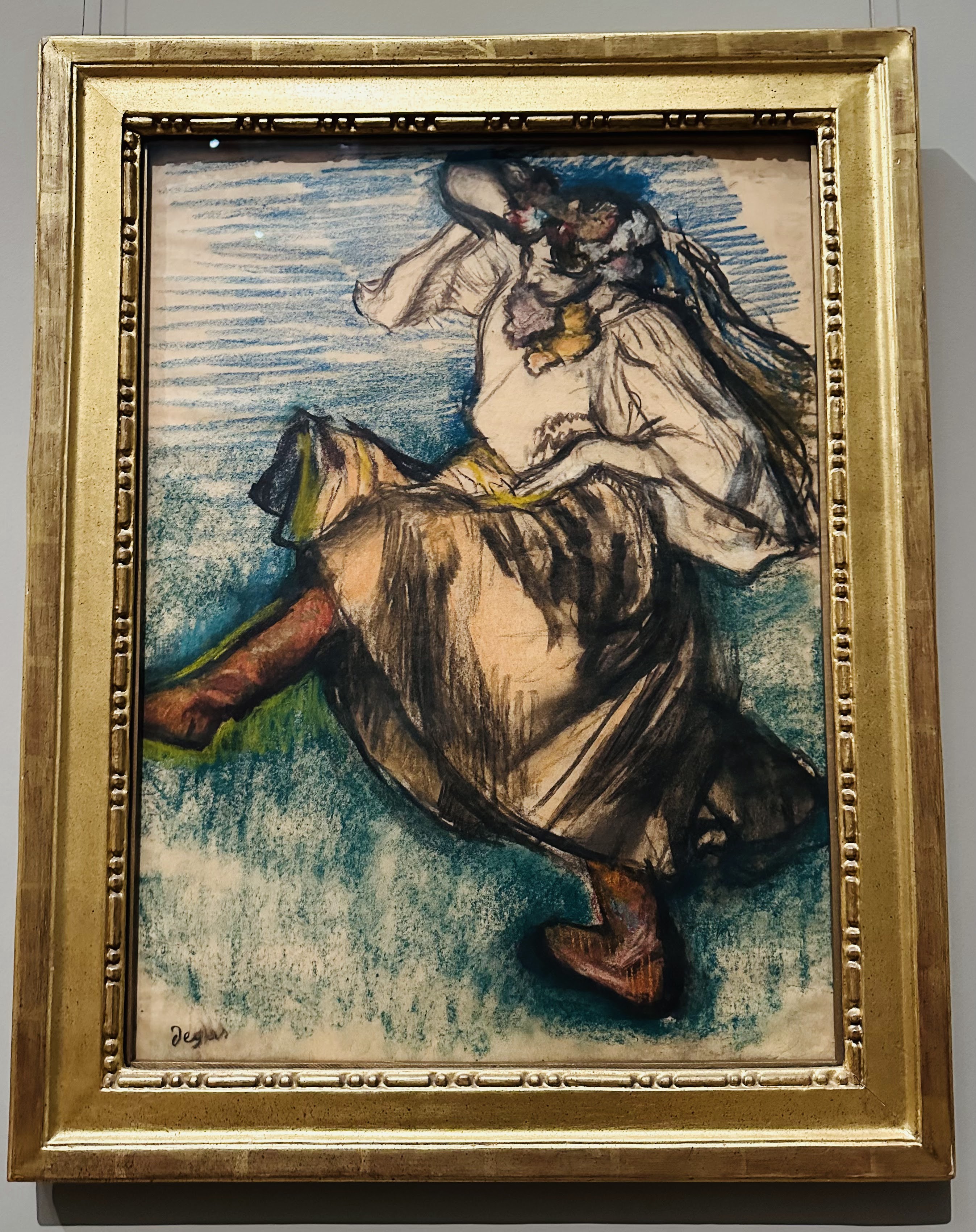
Dozens of Ukrainian scholars have opened new conversations about Russia as a colonial power and about the ways in which that colonial power has meant that Ukrainian artists and artworks have been ignored, misnamed, or minimized in European and American museums.  Last week at the Metropolitan Museum of Art in New York, I found at least two re-written labels on artworks, due, I feel sure, to the pressure of those scholars and journalists.  


Artwork and labels from the Metropolitan Museum of Art. My own not-very-good photos.

I wish the Met had actually owned up to what the previous labels had said, as a way to open up a broader discussion, but at least the change was made.  To learn more about Ukrainian art history and decolonization efforts, follow Oksana Semenik on Twitter at @ukr_arthistory, and for fascinating and important threads on Russia as a colonial power, follow Maxim Eristavi on Twitter @maximeristavi.  Many, many more folks are doing this work as well.

Individual actions are joined by collective actions. ICOM-Ukraine, the national committee of the International Council of Museums, has actively worked to have ICOM take a strong stand.  This past week ICOM-Germany did just that.  ICOM-Germany is the largest national committee so this stand takes a significant message to the larger museum community.  In a statement (read in full here) the committee said, 

With immediate effect, ICOM Germany is boycotting the Russian National Committee as the national association under the Russian flag. In principle, the German National Committee will neither cooperate with ICOM Russia nor participate in events at which representatives of ICOM Russia or Russian museum colleagues are present. ICOM Germany is also demanding that the Russian National Committee be suspended at international level. To this end, talks with other ICOM committees and ICOM International are being intensified. The aim is to completely stop working with ICOM Russia and to exclude the Russian National Committee from the world association until further notice.

The board of ICOM Germany shows solidarity with all democratic, progressive and liberal institutions and people in Russia. It is aware that the exclusion will also affect employees in Russian museums who work for peace and justice. However, the cultural sector must not permanently claim a special role or postulate a general impression of innocence. The systematic looting of Ukrainian museums, which according to current knowledge is supported by Russian museum actors and is an example of ethical transgression, should no longer go uncommented. The reports and pictures from Ukrainian museums speak a clear language. 


Fire extinguishers being delivered by HERI

 So what can you, with your single voice do?  

  • Listen, watch, read, and think critically.  
  • Amplify good work being done.  If you're a member of ICOM, can you encourage your national committee to join Germany?  Can you take a look at your own collections?
  • Contribute financially if you are able.  It seems as if local organizations/individuals on the ground are able to quickly deliver aid of all sorts than the big international ones (in my mind, World Central Kitchen is a notable exception and one I support for their work everywhere).  In the museum world, there's the Museum Crisis Center, founded and run by Ukrainian museum workers which is supporting both institutions and individuals.  The Heritage Emergency Response Initiative (HERI), also founded and run by Ukrainians, has focused on a wide range of support, much of it practical (generators and fire extinguishers, for instance).  HERI is now broadening its work to consideration of what post-war recovery efforts will look like for the cultural heritage sections.  All sorts of private citizens are raising funds to support both military and civilian needs.  For instance, The poet/musician Sergey Zhadan raises funds for drones, trucks, and other equipment for the army--so far, more than 100 vehicles.
Zhadan, upon receiving the Peace Prize of the German Book Trade last fall gave a speech on language and war (full text in English here).  And he ends with the future:
Like it or not, we will have to renew our sense of time, perspective, and continuity. We are fated to have a future. Moreover, we bear responsibility for it. Now, it is shaped by our visions, our convictions, our willingness to take responsibility. We will work at returning our sense of the future, since there’s just so much in our memories that demands our involvement tomorrow. We are all linked by this current that carries us, that won’t let us go, that unites us. We are all linked by our language. Even if, at a certain moment, its capabilities seem limited or insufficient. Nevertheless, we will be forced to return to it and its capabilities which give us hope that, in the future, there will not be any misunderstandings or anything left unsaid.

Dear Ukrainian colleagues and friends, the new visions, convictions, and willingness to take responsbility that Zhadan mentions, will surely bring a new peaceful future. 


Maria Primachenko, A Dove Has Spread Her Wings and Asks for Peace.

Thursday, January 5, 2023

My Top Museum/Heritage Experiences of 2022


2022 meant back to travel, which meant that I got to meet incredible people and see incredible places in person.  Here, in no particular order are some experiences that surprised, inspired and moved me.  But the most important is the final one, so please read on!


Difficult stories in Czechia

Last spring, I spent an incredible week out and about in the Czech Republic, in three very different locations, presenting workshops on telling difficult stories.  Stepan Cernousek and Petra Černoušková of Gulag.cz, joined by interpretation specialists Kristýna Pinkrová and Ladislav Ptáček identified three places with challenging histories.  The five of us loaded into a van and set off.  The plan for the week was to arrive at a place, give me a chance to learn about it, by meeting with local historians and others, and then do a workshop the following day.  From socialist industrial history to the oft-ignored history and persecution of the Roma people, to the Sudentenland, I learned so much and understood more about how past shapes the present. The workshops were wonderful, but what I remember more are the conversations--over breakfast, over dinner, and in the van, up and down roads across the country with four amazing folks, willing to answer all my questions, and help me ponder my own work and how we can make a difference.  Here's some reflections from the team.


Mammoth Dialogues in Texas

When the Waco Mammoth National Monument in Texas requested dialogue training from our team at Sites of Conscience, I really wondered how in the world I could train in dialogue around mammoths!  I didn't know anything about mammoths, and to be honest, not much about Texas.  But, off I went.  The great team at the site, including some really thoughtful interns, had backgrounds very different than mine--archaeologists and paleontologists mostly.  But, at the end of several days, the group, working together, had found so many interesting and important dialogues to consider using with their visitors.  Climate change--fossils help us understand that.  Evolution--absolutely.  How do we value and understand science and expertise?  Absolutely again.  I appreciated the willingness of this team to embrace new ways of working as they helped me learn too.


In Conversation with Clint Smith 

I first learned about Clint Smith when my husband said, "I just listened to this guy on Fresh Air that I think you'd really be interested in. I then devoured his book, How the Word Is Passed: A Reckoning with the History of Slavery Across America, recommending it to everyone I knew. As you can imagine, I was thrilled and honored when Amy Hufnagel from the Harriet Beecher Stowe Center asked me to be in conversation with Clint as a part of their Stowe Prize ceremony. which recognizes a distinguished book of general adult fiction or non-fiction that illuminates a critical social justice issue in contemporary society in the United States. In the book, he shares his visits to historic sites and the related conversations with visitors and staff, and his own reflections on those experiences, from Confederate graveyards to Monticello.

“Across the United States, and abroad, there are places whose histories are inextricably tied to the story of human bondage. Many of these places directly confront and reflect on their relationship to that history; many of these places do not. But in order for our country to collectively move forward, it is not enough to have a patchwork of places that are honest about this history while being surrounded by other spaces that undermine it. It must be a collective endeavor to learn and confront the story of slavery and how it has shaped the world we live in today.”

In a wide-ranging conversation, we talked about when he first knew he could be a writer (a third-grade poem), how history interpreters can be leaders in the needed conversations in this country, and how he views his work--and our work--as something that is not done for our generation, but for the generations to come. You can watch the full conversation here.


The Tenement Museum in New York City

In October, I joined my Sites of Conscience colleagues on a visit to the Tenement Museum.  97 Orchard Street, the tenement itself, is temporarily closed, but we saw an exhibition/installation about garment workers that I had not seen.  But my big takeaway here was not interpretation (though it was great), it was about what visionaries can accomplish.  Ruth Abram, the founder of the Tenement Museum was also the founder of the International Coalition of Sites of Conscience.  In a 2014 interview, she spoke about a key question for her work:

"Most of my life there's been a single question hanging over each thing I've done, whether in the women's movement or the civil rights movement, and it's how are we going to be one nation and at the same time appreciate, enjoy, and not be afraid of the sometimes profound differences we bring to the table based on our backgrounds?"

This was not, of course, what historic houses were doing in 1992. But over the last decades, the worldwide museum field (including the new definition) has moved closer to Abram's vision of museums and historic sites as places where we can "appreciate, enjoy and not be afraid."


Hadrian's Wall, United Kingdom

On a glorious November day, historian Joanne Sayner and her family took me off on a walk to the highest point of Hadrian's wall in the north of England. What made this memorable? It was a reminder of how large the Roman Empire was (just a month earlier I had been looking at Roman walls in the subway station in Sofia, Bulgaria). But it also was a chance to consider history outdoors, to see not only the wall, but also the varied landscape, altered over centuries. It was a reminder that joy and history can find places to work together. (a shout-out also to the very nice interpretive center, with its dialogic questions in an exhibit!)


Ukrainian Museum Colleagues

Here's the most important museum/heritage experience of 2022. As most readers know, I have a long deep experience in Ukraine, beginning as a Fulbright Scholar fourteen years ago this month. Until the pandemic, I had been able to return almost every year for one project or another, and have had the opportunity to travel all over the country, doing workshops, meeting colleagues, and learning a great deal. I have not been able to visit this year, of course, but I am in awe of the work that Ukrainian museum workers have done, showing courage and resilience under circumstances that few of us can even imagine. They have packed collections away, they have repaired damaged buildings, they have continued to do programming, in courtyards or subway stations underground, they have supported their colleagues in more dire need, they have shared their work to the world, working to decolonize narratives, they have asked for accountability from our international organizations. All this while they are working to keep themselves and their families safe. They are true heroes.  At the ICOM meeting in Prague, I had the chance to catch up with some Ukrainians in person (above, here we are at lunch) so this photo stands in for the thousands of colleagues doing challenging, difficult, meaningful work.

I want to encourage those of you who are able to contribute to supporting Ukrainian museums and museum colleagues. These are two locally-organized endeavors doing great work in Ukraine:

What did I Learn this Year?

As I look back and reflect on these experiences (and many more) there are a few important takeaways for me.

First, curiosity. I want to learn about places, about people, about the past, about where to eat the best local food (fabulous barbeque outside Waco!), the best beer (okay, all over Czechia), what different building styles mean and so much more. Accompanying curiosity is a willingness to ask questions and to acknowledge what it is that you don't know. I don't necessarily think of myself as a humble person, but it's true, curiosity is a kind of humbleness.

Second, believe that change is possible. From Ruth Abram's vision to Clint Smith's hope for the future, from tough conversations in rural Czechia to the work of Ukrainian colleagues--they all demonstrate that change is possible, but it requires not just hope, but also work.

Third, it's people that matter to me. It's not only objects or buildings that created the memories, although they are a part of all these experiences. It's the chance to have conversations--in a van heading across Czechia, under a big tent with Clint Smith, and even on Zoom calls with colleagues (though thankfully fewer of those these days!). A particular shout-out to the best work conversation person for me, Braden Paynter. We laugh that we start from two different ends (he's theory, I'm practice) to get to some really interesting conversations about ways to approach our work, almost always meeting in the middle! I've learned about the value of silence from him, and he's learned, I think, about the value of jumping in from me. A lucky, deeply meaningful work pairing.

An informal fourth: try to eat local food wherever you are! Check out the end of the post for some of what I ate this year from Texas barbeque to Italian gelato to Czech dumplings to a giant Scottish breakfast.  If you're interested in general travel plus photos, in addition to museums, follow me on Instagram

And what else?
So many other experiences this year--too many to write about, so my intention for 2023 is to do more writing, more immediately, about what I see and learn. Deep appreciation to all those of you who I met along the way. Stay tuned for 2023. 


Saturday, March 30, 2019

Thanks J. William! My Fulbright Experience Ten Years On


The Fulbright Program aims to bring a little more knowledge, a little more reason, and a little more compassion into world affairs and thereby increase the chance that nations will learn at last to live in peace and friendship.
                                                                                     Senator J. William Fulbright

This week in New York City, I had a chance to catch up with Ihor Poshyvailo, now director of the Maidan Museum in Kyiv--the museum that will both memorialize the 2014 Revolution and serve as a platform for dialogue.  But equally important to me, he's the first museum professional I met when I arrived as a Fulbright Scholar in Ukraine ten years ago. We've figured out how to get together almost once a year--once at AAM in Seattle, during his own stint as a Fulbright Scholar in Washington, DC, and often in Ukraine, including a series of workshops on Visitor Voices in Museums in cities all over Ukraine, along with our friend Eugene Chervony. (Road trips in Ukraine are their own unique experience).

Those ten years have been full of changes for both of us:  new jobs, new travel--and plenty of deeply concerning changes in both our countries as well. But also I think this connection--and the many, many more I still have with Ukraine--are evidence of exactly what Senator Fulbright imagined when introduced legislation for this program in 1945, just after the end of World War II.  

My international experience was really limited when I applied to be a Fulbright Scholar.  I had done an AAM/ICOM exchange in Hungary and had traveled in Europe with my husband and daughter.  But I had never lived anywhere else full-time.  I wanted to challenge myself, so applied, and thankfully, the Ukraine Fulbright Program had (and continues to have) a significant commitment to cultural practitioners coming to and from Ukraine in the program.  

It's hard to put into words what I learned from my Fulbright experience.  But here are a couple paths I've been down as a result:
  • Watched with pride and appreciation as Ukraine's museums changed over the decade:  new leadership, new ideas, new exhibits and programs that challenge a single hegemonic narrative.  
  • I've evaluated the state of Ukraine's national outdoor museum, judged a pottery competition, studied Ukraine's cultural heritage policy, and taught a course at Kyiv-Mohyla University (a big shout-out to my understanding students the first year).  
  • I first met Rainey Tisdale, my amazing co-author of Creativity in Museum Practice because she was doing a Fulbright at the same time in Finland.  We found each other's blogs and found much in common--and eventually a book!  And in 2017,  that book was also published in Ukrainian.
  • Fellow Ukraine Fulbrighter Sarah Crow and I discovered a shared love of Ukrainians' approach to food and founded the Pickle Project, leading to, among other things, a summer of train-riding and eating all over Ukraine as we learned that civic engagement and food go hand-in-hand.
  • I came to love--and understand a bit--about all of Ukraine.  I studied industrial history in Donbass; visited Crimea and learned about Crimean Tatars thanks to Peace Corps volunteer Barb Wieser; drank mid-day shots in the Carpathians with cheesemakers; and celebrated April Fools Day in Odessa.  
  • Shared ideas at American House in Kyiv on creativity, dialogue and more, thanks to Christi-Anne Hofland
  • Worked on exhibits about those who still work at Chernobyl, human trafficking, and a connected story of quilts, Mennonite, Ukraine and the Netherlands (shout-outs to Michael Forster Rothbart and Olga Dotter).
  • I watched online with awe as my museum colleagues--along with so many Ukrainians- stood in protest on Maidan to usher in the 2014 revolution and now, five years on, see so many of them still working to build the nation they imagine and deserve.
And out from Ukraine came so many other experiences:  museum-going adventures in Prague, Moscow, and the Netherlands with Irina Leonenko (actually maybe the first person I met in Ukraine).  Teaching in Latvia and Lithuania; workshops in Romania and Albania; and now my job at the International Coalition of Sites of Conscience.  I travel now to all kinds of places (last week, Istanbul!) and I always bring what I learned from my Fulbright experience:  to connect with people, to really listen, to bring a sense of appreciation to every culture and every place, to be my authentic self.

After proposing significant cuts in the program the last two years, thankfully the current administration has proposed level funding for 2020. I encourage all of you to consider applying for a Fulbright.  Here's information on the Fulbright Scholar Program and here's information on the Fulbright US Student Program.  If you're reading this from outside the US,  just Google Fulbright and your country and it will probably bring you to your own country program.

At some point during lunch on Thursday, Ihor and I looked at each other and said, "transformative."  That's what it was for both of us.  It can be the same for you.


Saturday, January 6, 2018

2017's Baker's Dozen of Memorable Museum Experiences


Like 2016, 2017 brought me many memorable museum experiences--that's memorable in a good way. Of course, there were a couple that were memorable in the "oh, no" kind of way, but in a spirit of generosity, here's what I saw, experienced and felt last year that I find myself sharing with friends and colleagues. As I went through selecting photos, I realized there were many more places I could have included on this list. It's encouraging to see how many museums and historic sites are working hard to push boundaries, to think more deeply.


American-Swedish Institute, Minneapolis, MN
Last January, I spent a few days at the American Swedish Institute, helping them jumpstart an interpretive planning process.  This wasn't necessarily memorable because of exhibits I saw, but rather because of the commitment of board, staff leadership and staff.  They embraced new ideas, did all their advance reading (!) and took a memorable field trip off to a local global market to see what they could learn. They're a great example of building a learning culture inside a museum, for staff, not just for visitors.


Torbay History House, Torbay, Newfoundland, Canada
A tiny museum-to-be in Newfoundland, Canada reminded me of the vital place museums can play in communities. I conducted focus groups last winter with students, scouts, parents at the library and the community at large. Everyone had ideas for exhibits, programs, and ways to use a new building for the museum. When the plans had their public meeting this fall, it was one of the liveliest, in the very best way, discussions.  "Could we do this?"  "Oh, I like that," "What will happen here?"  A case study for how opening up a planning process from the start can lead to greater buy-in.


Museum of European Cultures, Berlin, Germany
German colleague and friend Katrin Hieke met me in Berlin for a whirlwind weekend of museum-going. I envisioned the Museum of European Cultures as a dusty place, but far from it.  We took a Tandem (two languages, but actually closer to four) tour with a curator and a refugee artist of the exhibit da Heim: Glances into Fugitive Lives. Read my full post to understand why it was so meaningful, important, and deeply emotional.  It was the kind of exhibit and community collaboration I wish we could all strive for.


Creativity Workshop with local museums, Lutsk, Ukraine
This spring, Rainey Tisdale and I made a week-long, fast-paced trip to several Ukrainian cities to celebrate the Ukrainian publication of Creativity in Museum Practice.  As always, it was great to see friends and colleagues, but the time I particularly remember is at a museum in Lutsk, in western Ukraine, where museum workers and students jammed into a too-small room as enthusiastic workshop participants to learn how to build their own creative practice.  Their team efforts on developing exhibits on some social aspect of Soviet life, for an audience of teenagers, were judged by university students.  The combination of laughter and nostalgia combined with remembered fears and uncertainty was quite astonishing (and surprising to our Ukrainian colleagues as well). My relationship with Ukraine now goes back 8  years, and I continue to appreciate colleagues' progress in still-challenging times. A reminder that change is always possible.


Kigali and Murambi Genocide Memorials, Rwanda
I think about the day of these visits often. Rwanda is a spectacularly beautiful country and so the 1994 genocide seems almost unimaginable.  They tell a recent, still unresolved story, and in both cases, also serve as the final resting place of thousands of Rwandans killed by their neighbors. It challenged my ability to do my work (how can I make a real difference?) but at the same time, reinforced the importance of the work of Coalition members, and that a starting point for real change is empathy.


This Ever New Self: Thoreau and His Journal exhibit at Morgan Library, New York, NY
In this exhibit, words, rightly so, took center stage.  Thoreau's words felt fully contemporary.  The thoughtful design and curation really made the objects, including those journals, matter.  I found deep resonance in his words with my work at the International Coalition of Sites of Conscience this year.


Tea Plantation Workers Museum, Kandy, Sri Lanka
This museum is up a long, long way into the Sri Lankan highlands, deep into the tea plantations. One of the great gifts of my travel, particularly this year, is to learn about histories I knew nothing about. The Tea Workers story is one of colonialism, of identity, of nationalism, of persistence, and of family--and I found it all in this tiny museum.  The lesson from here?  Seek out tiny museums to learn about the people and places you're in--go beyond being just a tourist visiting the hot spots.


Casa Azul, the Frida Kahlo Museum, Mexico City
A number of years ago, I heard someone from this museum speak at an AAM meeting, and I've been interested in going ever since I got the chance. It was worth the wait and lived up to my expectations. First, it's a really beautiful and spectacular place, full of amazing objects that provide deep sense of Kahlo and her work; second, we visited on Day of the Dead weekend, so it was even  more thrilling with a huge altar installation; third, the way the house integrates inside and outside felt calm, even on a crowded day.  And lastly, the visit also included a fascinating exhibition on Kahlo's clothes tocusing on how she used clothing to both hide and step forward.


Museum of Popular Art, Mexico City
I actually didn't get to see very much of this museum, as we were only at a reception there. But there was a spectacular addition to the reception:  illuminated walking hand-made giant creatures making their way through the park to the museum. I had done a session on getting out of your comfort zone at the CAMOC conference, inspired by Annemarie de Wildt's ever-active Facebook page; and she demonstrated the value of that notion immediately, as she waded into great conversations in bits of English, Spanish and French, with the makers.  Creativity and curiosity flourished together in a memorable evening.  How can you inspire the same in your visitors to get them outside their comfort zones?


Gemeentemuseum Den Haag (Municipal Museum), the Hague, the Netherlands
I approach technology in museums with some skepticism.  I know, that's a blanket statement, but I want to technology to be a tool, not the means, and that doesn't happen often enough.  My dear friend Irina Leonenko, her son Nikolai, and I bicycled off to this museum and I found a total surprise. In the museum's Wonderkammer you receive an iPad to explore a whole series of rooms, answering clues and collecting objects.

Several things I really liked: the tablet was just the activator and each room encouraged different kinds of learning and participation.  We danced in time to a Mondrian painting, learned about glass making and identified tools, listened to tales of dragons and digitally put ourselves in historic costume.  But then, in a way hard to explain, we found ourselves in the large center gallery space, with tiny objects, and we used the objects we'd collected to design our own exhibition and digitally, our tiny selves entered the gallery, cut a ribbon and enjoyed the space.  I can imagine going back again and again, as every time the experience would be different.


We Have a Dream exhibition, Nieuwe Kerk, Amsterdam, the Netherlands
It was pouring rain in Amsterdam, and as I crossed a street, I saw giant images of Gandhi, Mandela and Martin Luther King.  Curious (and wet), I ducked into the Nieuwe Kirk, a spectacular space, to find an exhibit that looked at three giant figures of the 20th century.  The exhibit had few objects (although I appreciated Gandhi's bicycle in this cycling city) but the graphics, including text, were eye-catching and direct. The exhibit encouraged us to think about these men as not just historical figures, but as people who continue to inspire, even including contemporary heirs, such as the Black Lives Matter movement.


Terezín Memorial, Terezín, Czech Republic
Terezín is one of the founding members of the International Coalition of Sites of Conscience and was the site of our 2017 European members meeting so the site and the chance to meet our members are inextricably linked.  The entire site represents layers and layers of history--from an 18th century fort to a "model" detention camp for the Nazis to a museum and almost uninhabited town today.  The education staff at Memorial have created a number of programs for young people, for whom Nazism is distant history, to help them understand that those lessons carry forward to today.  We all felt warmly welcomed by all the staff, despite the site's cold and chilling history. It didn't require much imagination to see where those railroad tracks led; but at the same time, the creative spirit of those in the camp was very much in evidence.  The lesson for me here?  Embrace the complications.


Loja das Conservas, Lisbon, Portugal My last one is not actually a museum, but provided the best kind of museum-like experience.  Loja das Conservas is a store created by the canned fish association of Portugal and selling only canned  fish (conservas). If you're like me, white tuna in water is your idea of canned fish, you're in for a surprise.  But what made it like a museum?  Great graphics, and interpretive labels explaining each producer's work and history. We had a chance to sit down with a glass of wine and sample different products (as part of a great Context travel walk), with a very helpful staff member who explained the different types, and even got our non-fish eater to try a bit! I felt welcomed, had a great time,  learned something, and brought souvenirs home.  Just like a museum, right?

That was my year!  A shout-out to ICOM because my membership card provided free admission to many of these places.  I'm looking forward to another year full of big challenges, thoughtful museums, and incredible colleagues.  Stay tuned.

Monday, January 9, 2017

10 x 10: My Favorite Posts from the Last 10 Years


This week is the tenth anniversary of this blog. I couldn't have guessed ten years ago, that I would still be writing on a pretty consistent basis, nor could I have imagined all the places I would go, the experiences I would have, or the lessons I would learn (some easily, some definitely the hard way). To celebrate, I've gone back and chosen a favorite post from each year. These posts weren't necessarily the most-read, but the ones that speak to me still.

2007
My own lifelong learning and the chance to support learning through Donors Choose. On re-reading, an appreciation of my parents and of the chance to pay it forward.
Learning for a Lifetime

2008
This post, about a project for the Montgomery County Historical Society, is really about the power of listening to visitors and communities.  I still share this experience on a regular basis as it continues to resonate, particularly in these times.
The Story of La Guerra Civil or Why I Work in Museums

2009
I went to Ukraine for the first time this year, initially for four months as a Fulbright Scholar.  I blogged a lot this year--124 total posts.  Most posts were me trying to make sense of my time in Ukraine. In retrospect, I can see myself learning on the fly, even in some ways I didn't quite imagine. This year is also when my readership began to rise, as I was the museum person writing in English about museums in Ukraine and the post-Soviet world. This post, about a visit to Chernobyl, another experience that remains deeply with me.

2010
Upon re-reading this post, I was struck by the continuing importance of deep personal connections. One of the stories is about Crimea, more meaningful and poignant now.

2011
Not much extra comment needed.  Not much has changed since this post except more sustained attention to the issue of gender in museums.
Want to Be a Museum Director? Evidently, Be a Man

2012
I'm lucky enough that my work takes me to all kinds of museums and I enjoy reporting back on work that surprises, intrigues and stimulates me.  Here, a Parisian museum totally took me by surprise, in the best way.
When Was the Last Time You Were Surprised at a Museum?

2013
An interview, as history was being made, with my dear friend and colleague, Ihor Poshyvailo, about museums and Maidan. It's fitting that he's now director of the new Revolution of Dignity Museum in Ukraine.
"Our History Museums will Include the Events of These Days"

2014
Over the last several years I've written often about the process of re-interpretation at the Harriet Beecher Stowe Center. In this one, we're encouraged to give up chronology in the service of more interesting interpretation.
Surrender the Chronology!

2015
Connected to #museumsrespondtoFerguson, this post reflects on the ways I view my own responsibility to work for change after attending an AAM meeting.
We Are Not Separate from Politics: AAM and Beyond

2016
Back to reporting on surprising museums--and tremendous labels.
Brilliant Labels in Dublin: Sweets, Nudes and U2

Here's hoping for another ten years of museum visiting, drinking coffee, meeting all of you, traveling, blogging and learning.


Wednesday, December 28, 2016

A Baker's Dozen of Great Museum Experiences in 2016


I go to lots of museums every year. If you really want to know how many, you can check out the Google map I keep of my museum visits (museum nerdy I know). Some I go to for work, some for pleasure. Even with those ones visited for fun, I find myself pondering both the why and the how of the work we do. As I reflected about the year, I was always thinking about both the experience and the people I was with--clients, colleagues, friends or family.  This year's top ten roundup, turned into a baker's dozen, is all about the experiences.  Some of these connect to earlier posts, others were equally valued but never quite made it into the blog. I hope you enjoy them even a bit as much as I did. It's been a tough year, but there are always bright spots. I'll be curious if any of you see any common threads in what made my list. If so, please share your thoughts in the comments.

Frans Post:  Animals in Brazil, the Rijksmuseum, Amsterdam, the Netherlands
I love the Rijksmuseum for lots of reasons but I loved this exhibit when I saw it in November.  For seven years, beginning in 1636, artist Post was in faraway Brazil, sketching and painting flora and fauna.What made the exhibit great?  First, the drawings were discovered as part of a digitization project; second, it was a collaborative effort between an art museum and a natural history museum (see the llama above)  third, a witty, clean installation; and fourth, the exhibit encouraged deep looking and drawing. It was just fun, made more fun by seeing it with an old friend and museum-lover Irina Leonenko.


Columbus Art Museum, Columbus, Ohio
The Columbus Art Museum has made creativity the centerpiece of their work. Rainey Tisdale and I were lucky enough to get a walkthrough of their galleries with Cindy Foley, Deputy Director for Learning and Experience and we got to see a museum that embraces creativity in full flower. For instance, many museums would balk at putting a big jigsaw puzzle right in front of the work of art, as above. But these two visitors (notice, adults) were engaged in deep closing looking. They would pick up a puzzle piece, come in close to the painting, look and ponder, go back to the puzzle, talk to each other, and repeat. They spent far more time in front of this painting than they ever would have without this encouragement. In a gallery featuring American art, they're working to expand our ideas of the "American story," visitors were invited to share where their American story begins, and their vision for the future. 


Ukraine's Cultural Heritage Sector, Kyiv and L'viv, Ukraine
This fall, I returned to Ukraine with Lithuanian colleague Vaiva Lankeliene  (that's her above, with our thoughtful colleague Vasyl Rozhko, digging into data over coffee in L'viv) to assess the state of Ukraine's cultural heritage. It was incredible to have to opportunity to think deeply about not only the present but the past and the future. I found, not surprisingly, some everyday heroes who can inspire all of us as they work to shape a nation's future.


Royal Newfoundland Constabulary Headquarters Exhibit
It was something entirely new for me to do an exhibit in a police headquarters. Thinking about audiences was challenging. But that's not what made this experience memorable.  It was that I had the chance to think about community in an expanded way. The Constabulary (the oldest police force in North America) is a community unto itself, with long, proud traditions. They wanted to honor those traditions but also wanted the exhibit to reach out to the greater Newfoundland community in the same ways they connect every day with citizens. Huge credit goes to the museum committee, headed by Jim Lynch, who were willing to let talented designer Melanie Lethbridge and I put forth different ideas on both concept and design. This volunteer committee was far more willing to talk and think about risk-taking in exhibits than many museums.


Big crowded art museums are always tough. There are too many people, my knowledge of art history never seems quite enough, the labels are either amazingly uninformative or filled to the brim with art historical terms I don't understand. Over the last four years of working with Context Travel, I've had the chance to take some great walks in great cities and museums. Last winter, in Florence with Context staff, I was tired, had a cold, and initially thought, oh, I can skip this. I've been to the Uffizi before. But Alexandra Lawrence, a Context docent (the word the company uses for their guides) and art historian, made the Uffizi make sense to me. She put forth a clear theme for the walk, returned to it throughout, carefully selected individual works to move that forward, and had us look deeply, all the while sharing her own great enthusiasm.  The kind of museum tour we all want and rarely get.  I left feeling both renewed and smarter.


Without a doubt, the best labels I saw all year. Funny, irreverent, thoughtful, meaningful--and somehow they absolutely reflected the spirit of the city. At the same time, the labels never shied away from the political--from women's rights to the 1916 Uprising.


I'm a former Girl Scout myself but honestly, hadn't thought much about the experience in years until Lisa Junkin Lopez, director at the Juliette Gordon Low Birthplace in Savannah asked me to do some evaluation of a new visitor experience, the re-imagined Library. JGLB has a great staff, up for anything, but what made this experience really great were the girls themselves. Girls who were inspired, who wanted to change the world, who believed that they could invent and be anything.  In these challenging times, it was a great reminder that our museums can, and should, inspire all kinds of people, in all kinds of ways.  


I arrived in Riga last January to facilitate a series of workshops. But one of the first things that happened was to get a tour of the newly renovated National Art Museum from Una Sedlience, their deputy director. In the dark late afternoon, we got to wander through this beautiful building--before the art was installed. Up grand staircases, into magnificent rooms, through up-to-date open storage waiting to receive the paintings, and then up on the roof, overlooking the historic city. A magical experience in a gorgeous city.


At a workshop on increasing visitor engagement in exhibits, we experimented in the galleries devoted to Soviet-era history. Museum colleagues were asked to develop questions, post them near objects, and then, take some time and answer a question or two. I was blown away by the quality of the questions, and fascinated by the answers. Was the education system better?  Is your memory of Soviet times really the memory of your grandparents? Is collective better than individual? A grand experiment and one I'll long remember.


The Midwest Museum Association held its conference in Minneapolis this year, and a reception was held at the Swedish Institute. I've never been to a reception that was so much fun. I got to learn about outcome-based evaluation through beer tasting, ate amazing food, and participated in a crazy tour of the Turnblad Mansion. Scott Pollack, Director of Exhibitions, Collections and Programs, led us on a tour, accompanied by live music, where all of us where invited to tell a tale of the room we were in; followed by Curt Pederson, Curator of Exhibitions & Collections sharing a bit of the true story. Best of all was sitting down next to a board member who beautifully articulated a vision for the museum that's inclusive and welcoming to all.


Mystic Seaport, Mystic, CT
Rainey Tisdale and I facilitated a two-day planning session as Mystic Seaport's team was working on the first exhibition in their brand-new building. Using lots of different creative tools, the team dug deep into identifying stories that mattered. What made this great? Working with Rainey, as always (see below) and a team that really seemed to enjoy each other. Also impressive was the museum's leadership team who were full participants in the days. We found many connecting threads and now SeaChange is open and on my visit list for 2017.


If you were in DC for the AAM conference, you might have gotten to see this exhibit. It was up for what seemed like minutes, but deserved a longer stay in the Smithsonian's castle. I got to see it with colleague Andrea Jones providing us a great opportunity to dig into the work. Big ideas, challenging content, artists really interested in engaging in an incredibly broad swath of the public. This project had it all.  It reinforced my sense that long-term exhibitions may be headed the way of the dinosaur--that nimble, responsive projects are our future.


Museums and Your Whole Self, NEMA Session with Rainey Tisdale
This year's New England Museum Conference was unlike any other conference I've ever been to.  It began the day after the election.  There were tears, hugs, confusion, and more. Rainey and I had a session on the last day. Originally were going to use the election as our focus to explore how museums can connect to our whole selves, not just our learning selves. That seemed wrong--everyone was too drained.  Rainey convinced me that the right topic was kittens, yes kittens!  She was absolutely right, and those of you in the audience were great participants as together we built out our giant paper dolls with crazy ideas to connect with our playful self, our spiritual self and more. I left feeling buoyed, grateful and determined.  

I already know that 2017 will bring more great experiences, even greater challenges for all of us and more dots on my map. I'm looking forward to all the challenges and my best wishes to all of you for the same in your professional life. Be brave, take risks, have fun--put your whole self to use. For inspiration, here's advice from a young Girl Scout.

Monday, October 31, 2016

Heroes. Every. Day.


This election season in the United States has shown me, as I'm sure it has many of you, how easy it is to fray the threads of civil society.  Imagine Ukraine, a nation with a short democratic history, a just three-years-old revolution, occupied territories, and an ongoing war in the East.  Plus, the still-strong remnants of Soviet bureaucracy and a tenacious system of corruption that are a part of everyday life. For the past two weeks, I've been in Ukraine conducting an assessment of the cultural heritage sector with my colleague Vaiva Lankeliene from Lithuania for the Culture and Creativity EU-Eastern Partnership Programme.

To be sure, we've found many needs and issues in the sector in great need of reform. More importantly though, it's been great to see people that really are heroes--people who, in whatever way they can, are working to make museums and cultural heritage better. Their efforts are resulting, bit by bit, in those stronger threads that weave a stronger civil society together.

Here's what I mean:
  • Two years ago, a new staffer at the Ministry of Culture discovers there is virtually no information collected about the museum sector.  Using his own car, and paying for his own gas, he travels thousands of kilometers around the country, visiting museums and building statistical information that serves as critical benchmarks for the sector.  Sadly, he's now formerly of the ministry, but the useful data lives on.
  • A director of a historic house museum believes that her staff should be like family, as it is a family house.  They work together, everyone sharing responsibilities--everyone gives tours for instance, as a way of staying connected and making room for everyone to pursue their research and community engagement interests. The result is a museum that is more crowded than far larger ones.  The public feels the spirit of the place.
  • The collective work of the L'viv city administration who joined together to develop the newly-opened project The Space of Synagogues (below), an important and moving first step in integrating Ukraine's Jewish history into the nation's larger historical narrative.  It provides visitors to the World Heritage city a chance to contemplate and learn about an aspect of the city's history long erased.
  • The colleague who received a grant to work with museums in digitizing their collections and is meeting unexpected resistance to such a project.  Some are opposed to sharing work that, of course, belong to the public.  He persists, diligently, in convincing colleagues and pondering new ways of persuasion. Not surprisingly, he's finding that lower-level staff have significant interest in collaborating, but directors,  not so much.  I know he'll get there.
  • The head of historic preservation in a city, who works to control development in the historic center, despite the willingness of investors to go above her department to get a yes, when no was the right answer already given. She works with colleagues in other historic cities to develop and share guidelines for appropriate development, when most city departments are independent actors and information is hoarded.  Like it is for most of my colleagues here, corruption is the eternal subtext. Several museum directors mentioned wanting to have a lawyer on staff, because there is so much legal maneuvering, particularly about property rights.
  • The enthusiastic director of a tiny small-town museum who wishes for more opportunities for professional development.  But, he cheerfully says, I took an online course on grant-writing, wrote a grant and got it. The result:  a series of public programs, tourist guides and walking tours.
  • Two young staff members at a contemporary art center talk about their role as building up confidence and motivation among not just their staff members, but the community as well. They connect closely the ideas of public and personal responsibility in the realms of art and life.   Said one, the result of the 2014 Revolution was that people now understood: "No one will fix our problems.  We have no illusions left.  We just have to move our ass."
That last statement, and all my experiences this trip, have reinforced Margaret Mead's belief,
Never doubt that a small group of thoughtful, committed citizens can change the world; indeed, it's the only thing that ever has. 
Changing the world one day, one step at a time.  Heroes.  Every. Day.

From the new memorial in L'viv