Showing posts with label #museumsarenotneutral. Show all posts

Saturday, October 24, 2020

Blogging, What Blogging?


I last wrote a blog post on May 31st of this year.  That's just about five months ago.  I've blogged for more than a decade and have never gone more than a month without writing a post. My goal used to be a post every week.  But I have struggled to find what it is I want to say.   Travel fueled my thinking about museums--meeting colleagues, visiting museums, and sharing what I learned along the way.  So that's left a hole in my thinking--and writing.

But more importantly, I've struggled to think that I have anything useful to add to the deep and important conversations around museum change happening now.  I am in awe of those bloggers who have continued to write--not just to write but to write important words that we should all be listening to--and acting upon.  Like many of you, I've also been overwhelmed by the amount of great content in terms of webinars and online conversations. 

I wanted to share some of the writing--and watching--that has resonated with me.  Here goes:

Porchia Moore, everywhere she appears:  in particular, Cartography:  A Black Woman's Response to Museums in the Time of Racial Uprising and Reflexive Cartography:  Or a Ritual for the Dhying Museum Landscape--the Socio-Political Impact of Change in Museums, both on the Incluseum.  These posts made me think in entirely new ways.

The ongoing work of Mass Action, in particular the Readiness Assessment.

Joan Baldwin's weekly posts (and I am in awe of that!) at Leadership Matters. where she often takes a broader societal issue that's emerged that week and encourages us to consider in our museum context.

My colleague Braden Paynter at the International Coalition of Sites of Conscience facilitates weekly webinar shorts, 30 minutes of great conversation on everything from Definitions of Justice to Finding Joy to Facilitating Digital Dialogue.  The webinars are all recorded--and they are free for all to attend. Check them out!

The Instagram account @changethemuseum, important, heartbreaking and infuriating in equal measure.  We--particularly us of an older generation in the museum field--have a great deal of reckoning, listening, and changing to do.

Andrea Jones of Peak Experience Lab (and now at the Anacostia Museum) has only written one blog post during the pandemic, but it really mattered:  Empathetic Audience Engagement During the Apocalypse

Death to Museums online presentations and discussions on everything from calling out racism at specific institutions, to exorcising ghosts of the Confederacy.  Also, more of Dr. Moore!

Upcoming, I'll be reading Dan Hicks' new book The Brutish Museums The Benin Bronzes, Colonial Violence and Cultural Restitution. Dan was kind enough to respond to a Twitter stranger and meet me for a lively conversation when I was in the UK in February (remember travel?).  For Dan's perspective on the UK culture wars these days, check out his recent piece in the Guardian.

And I would be remiss not to mention the incredible effort of Paula Santos and others for the Museum Workers Relief Fund.  As all of you know, museum workers, particularly front-line workers and museum educators have been devastated by the pandemic and museum closures while, in some cases, billionaire board members have refused to step up and support the museum they ostensibly serve.  In the meantime, almost 1000 donors (including me) have donated $68,000 to support laid-off museum workers.  

What else have I done during the pandemic?  participated in many, many zoom calls, in multiple languages, and appreciated the changing seasons in the place I live, the Catskills of upstate New York.  I can't wait to travel again, but I'll see if this simple post gets me back blogging.  In the meantime, deep gratitude to all of you who write, speak, and inspire.

Saturday, January 11, 2020

Museum-Catch Up #3: No Labels Needed


We went to Mexico City for Christmas and visited lots of museums--a lot!  This is just a quick post about the National Museum of Anthropology.  The collections here are tremendous--I learned a great deal about cultures I knew little about.  Objects were beautifully displayed, labels were useful, and I loved the way the museum used both indoor and outdoor space.

But there was one place where a label wasn't needed--the objects themselves made an impact on me.  You can see it at the top of the post. After going through all of the exhibition galleries on the ground floor with the evidence of sophisticated cultures, this two objects are displayed side-by-side:  a simple wooden cross, evidence of European colonialism and a stone statue with the features destroyed, a visible symbol of the Spaniards' efforts to destroy existing cultures.

It was a great juxtaposition and one I'll long remember.  #MuseumsAreNotNeutral.

And, just because, some other images from the museum below.


Sunday, December 8, 2019

Museum Catch-Up #2: Rethinking in Amsterdam


I got to spend a very quick weekend in Amsterdam this fall, and saw two museums rethinking in big ways. The Amsterdam Museum's decision to remove the name "Golden Age" from its description of the Netherlands got lots of press around the world.  Thanks to my friend Annemarie de Wildt, a curator at the museum, I got to attend the opening of Dutch Masters Revisited, an installation within the permanent collection at Hermitage Amsterdam.   The permanent exhibit is a huge hall of group Dutch portraits--and the temporary installation is 17 portraits of prominent Dutch citizens depicting a diverse group of people who, based on historical research, are known to have lived in 17th- and 18th-century Netherlands.   Curator Jörgen Tjon A Fong of Urban Myth brought the group of photographers and citizens together for meticulously created shoots. There was a great deal to appreciate (warning:  many label images ahead!)


  • the museum explains what it's doing and why.
  • the contemporary portraits are really integrated into the gallery itself.  They're not off in another room or small scale.  They have the same grandeur and importance of the historical works

  • the museum connects past to present in numerous ways. Although I didn't necessarily love the hallway portraits of today's civic organizations, I did appreciate, that within the exhibit, you were encouraged to donate.


  • Labels had provocative titles, asked good questions, asked you to reflect, and provided some surprising info about Amsterdam--without being overlong or info-loaded.

At the opening reception, Margriet Schavemaker, artistic director of the museum, noted publicly that she had recently returned from ICOM in Kyoto, and reaffirmed that although the new museum definition was not approved, it would be the way the Amsterdam Museum is working and will continue to work (for more on that conversation, see this blog post).

Probably five or six years ago I had visited the Tropenmuseum and found it a bit sleepy--a sort of old-fashioned ethnographic museum.  But on this visit, I found it transformed--in approach, in look, in a serious rethinking of their work.  Such a pleasure!  Just a few examples grabbed in a quick visit are below.

Their permanent exhibition, Things that Matter, connected material from around the world with a wide range of contemporary issues--from migration to climate change to the use and misuse of traditional culture by others.  All the issues were framed as questions:

  • When do you feel at home?
  • When is culture yours?
  • What do you believe in?
  • What brings back happy memories?
  • Is the climate changing your culture?

It was fun to dip in and out, and the large scale video installations really worked in the big space.


I was particularly interested in the exhibit Afterlives of Slavery, described as "an exhibition with a discussion platform that places the stories of the enslaved and their descendants centre stage."  The exhibit looks at both the history of enslaved peoples, but also, how those histories continue to impact the Netherlands today (see ongoing examples of controversy around Zwarte Piet).   I liked the feel of the exhibit, as if it really was an ongoing discussion.


I did wonder though, about the emphasis on the history of enslaved peoples in the Caribbean, as related to the Dutch, and why nothing about the history of the Dutch and slavery in what is now New York State was mentioned.  I'd love to see those connections made.

In both these exhibits, I felt like there must have been many many meetings -- and some prototyping--of questions for visitors.  I loved that these were big questions, without single answers.  They were ones that would encourage conversation among visitors.

At both museums in Amsterdam, I felt a kind of courage paired with necessity:  a sense that it has taken museums far too long to address these issues, and the importance of making change.  Although every museum may not be able to afford beautiful portraits or large-screen videos--it's the thinking that matters here.  And that, of course, comes for free!

What else did I do in Amsterdam in a single weekend?  Why of course, ride a bright red bike with AnneMarie and explore the city!  What could be better than exploring a city with a city museum curator?


Sunday, September 15, 2019

In the Room Where It (sorta) Happened: ICOM's Museum Definition


Last week, along with 4,000 or so other museum folks, I was in Kyoto, Japan for the triennial International Council of Museums conference.  Both before and after the conference, there has been a great deal of discussion--among museum colleagues and in the public sphere--about a proposed new definition of museums.  I tweeted --and retweeted others--pretty extensively during the loooong general assembly about the definition.  Now that I've been back a week and had some time to reflect, I wanted to share some thoughts about process and product.

What is ICOM anyway?
To begin, more than a few Americans wondered about why anyone would care about what ICOM did in the first place--and who were those people voting?  The US is fortunate to have a strong collection of professional organizations--AAM, AAMD, AASLH and state and regional associations.  But in many places in the world,  the ICOM national committee might be the sole functioning professional organization.  In the same way that many US museums look to AAM for standards and guidance, so do museums around the world look to ICOM.

There are 119 National Committees and 30 International Committees, along with 6 Regional Alliances and a number of affiliated organizations.  There is an Executive Committee and a Secretariat, which is based in Paris.  Voting is done, not by members, but by these committees, alliances, and affiliates.  National committees have the most votes, but, in American terms, it's like the Senate, not the House, with each country having the same number of votes.  As I was in Kyoto representing the International Coalition of Sites of Conscience, an affiliate, I was able to cast two votes. 

If you're a working professional or a student--you can become an ICOM member (link for US membership)-and participate in any international committee.  It's a great way to connect with colleagues around the world and, as it happens, an ICOM membership gets you into almost any museum in the world for free.   So the "them" is in fact us, if you choose to participate. The conference itself is cheaper than many US conferences. From my perspective, even before I began working for the Coalition, I found it extremely valuable to learn from colleagues around the world--particularly as the US museum system is quite distinct from most other places.  ICOM plenary sessions took on important issues:  climate change and sustainability and decolonization.  It's important that these discussions take place with colleagues from around the world able to participate.  Dozens of international committee sessions also explored a wide range of issues.

The Definition
But now, to the proposed new definition and the debate around it. For a comprehensive look at coverage of the definition process, thanks to Anna Marras and Ana Carvalho for gathering all the press coverage and discussion into one place.  It keeps growing, so check it out!

During the week, a plenary session was held when those on the definition-writing committee (Museum Definition, Prospects and Potentials Committee) spoke in favor of adopting the definition and space was also given to those who were opposed.  The new definition proposed was:
Museums are democratising, inclusive and polyphonic spaces for critical dialogue about the pasts and the futures. Acknowledging and addressing the conflicts and challenges of the present, they hold artefacts and specimens in trust for society, safeguard diverse memories for future generations and guarantee equal rights and equal access to heritage for all people. 
Museums are not for profit. They are participatory and transparent, and work in active partnership with and for diverse communities to collect, preserve, research, interpret, exhibit, and enhance understandings of the world, aiming to contribute to human dignity and social justice, global equality and planetary wellbeing.
And the current definition, adopted in 2007:
A museum is a non-profit, permanent institution in the service of society and its development, open to the public, which acquires, conserves, researches, communicates and exhibits the tangible and intangible heritage of humanity and its environment for the purposes of education, study and enjoyment.
Full disclosure:  as a representative of the International Coalition of Sites of Conscience, an affiliated organization, I was prepared to vote for the definition.  I considered it too long and not straightforward enough, but I believe in the ideas it puts forward.  However, through a series of  maneuvers, not clear to most of us in the room, the vote on the definition was postponed, with 70% voting for postponement.

From my perspective, objections to the new definition vote fell into four categories:

1.  Process
Although this was described as the most open process ever at ICOM,  many national and international committees felt there was not adequate time to consult with members before the vote.  It's important to note, that as far as I know, voting delegates were not bound by the consultations with their members, if they happened.  ICOFOM, the international committee focused on museology, took initiative and held a series of roundtables about the museum definition.  The summaries are here, but notably, the roundtables were unevenly distributed around the globe (heavily weighted towards Europe) and the approaches were varied. 

I'm not sure what the process should be going forward, but I do know that if it is to be a global definition, then the conversation needs to be global.  The vast majority of those speaking in the General Assembly were white Europeans or Americans.  A more inclusive format needs to be developed and more voices in the conversation. 

2.  Aspiration or definition?  (plus wording)
Do we need a definition?  Is this too wordy?  Who even uses the word polyphonic?  Are museums really this?  Is this an aspiration rather than a definition?  Some were concerned that the word education was not included, for instance, although to me, it is embedded in the entire definition. I think a definition can be helpful, but I also think that all of you who are doing the work towards real change in our field will keep doing that work no matter what. A definition may or may not matter to you, as you work with communities.  But imagine that it might matter to those who are just starting this work, in places where the work of social change is not yet accepted as an effort of museums (that might be specific museums or it might be entire nations).

3.  Impact
There were concerns that the ICOM definition is embedded in law in some nations and that a changing definition (for instance, the removal of the word 'permanent') would have critical repercussions.  Moving forward, there needs to be clear and substantive analysis of this, and at the same time, ICOM should be prepared to provide advocacy tools and training for countries where this might be an issue.

4.  Fear
Although these objections were sometimes couched in the language of the items above, it seemed pretty clear that some of the objections came from those who were afraid of change, afraid of surrendering their institutional power, afraid that museums were becoming too ideological.  Of course, museums have always been ideological.  In Time magazine, Jette Sandahl, chair of the committee, commented, “We need to work with relevance into the context we live in, and this certainly makes that clearer. There is no apolitical space or point of view. Museums are always political.”   I remain hopeful that fear will not win the day.

Is the Controversy Bad for Museums?
I think the press coverage is great.  I don't think it makes us look silly or divided.  I think it makes us look like a field that is thinking deeply about the work we do.  It's hard work and I'm happy to see us doing it. I'm impatient with those who fear this could divide the field permanently.  In my work at Sites of Conscience, I see people coming together in reconciliation over far more difficult, life-changing issues than a museum definition.  Surely we can do the same.

What's Next?
I assume the ICOM leadership and staff have barely had a moment to take a breath since the end of the conference.  So we don't know what's next, but it's my hope that whatever next is truly a global conversation, and that the traditional European powers of ICOM step back and provide some additional space for other voices.  Together, we can move museums into the 21st century--and not a moment too soon.


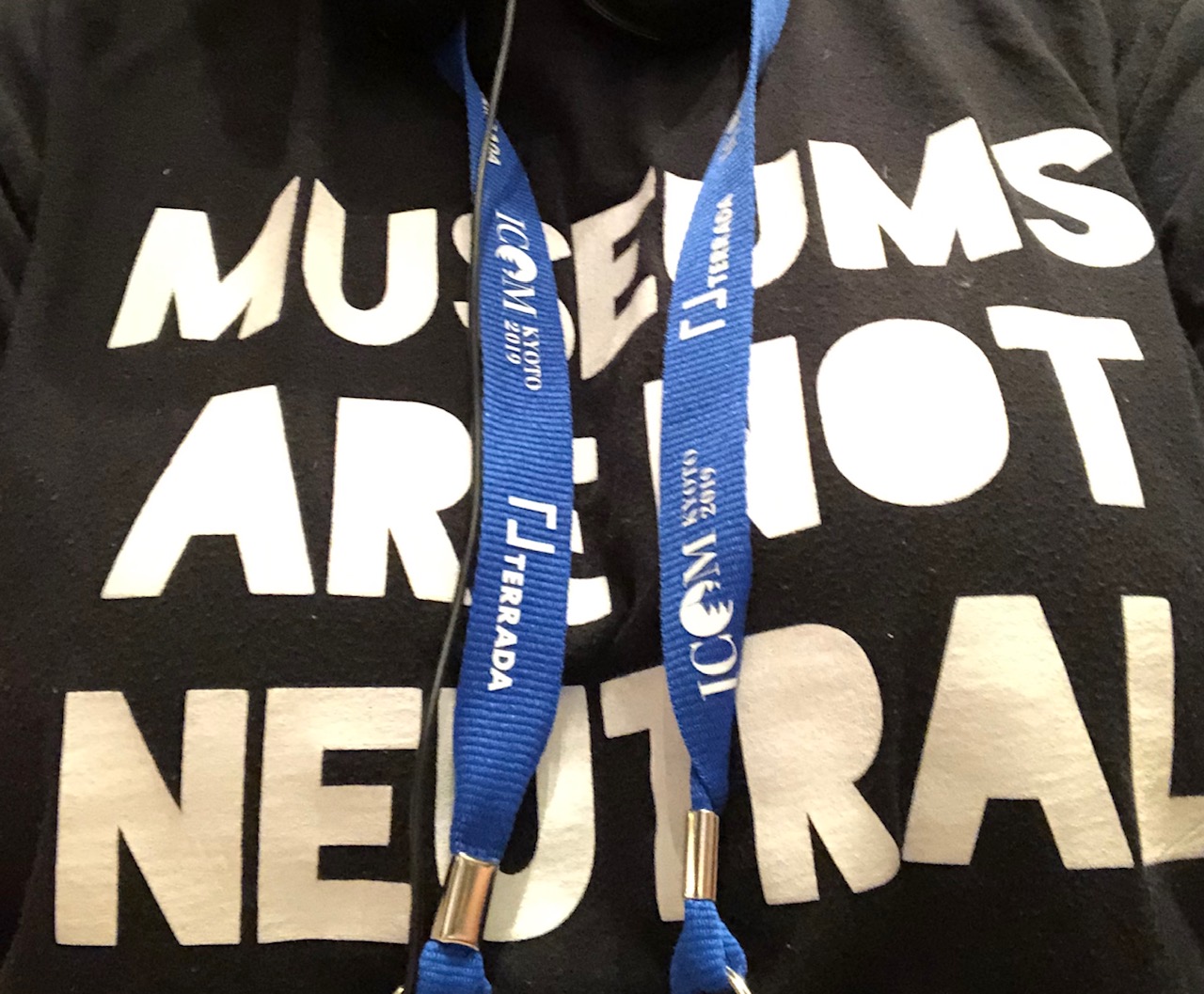
Thanks LaTanya Autry and Mike Murawski, creators of  #museumsarenotneutral for providing inspiration--and a T-shirt to wear the day of the definition vote (or non-vote).