Sunday, September 25, 2022

Manifesta 14: The Stories in Pristina


In late August, my colleague and friend Annemarie DeWildt and I set off (see previous post) to Pristina, Kosovo to explore the art at Manifesta 14.   

Manifesta, headquartered in Amsterdam, describes this year's event:

rethink[ing] the relation between culture and civic society, investigating and instigating positive social change through contemporary culture in response to, and in close dialogue with, the social sphere of the Host City and its communities. Manifesta has consistently chosen unexpected host locations that reflect Europe’s ever-changing DNA to shed light on a world defined by changing ethical and aesthetic imperatives. Manifesta, as a recurring event, has transformed itself into a multilayered and inclusive instrument of civic engagement projects. In 2022, Manifesta 14 Prishtina will take place in Prishtina, Kosovo. Manifesta 14 aims to support the citizens of Kosovo in their ambition to reclaim public space and to rewrite the future of their capital as an open-minded metropolis in the Balkans and in Europe through the development of a new cultural institution.

I had encountered bits and pieces of a previous Manifest, in 2014 in St. Petersburg, Russia, and needless to say, this was quite a different experience. Kosovo is a young country, having declared its independence from Serbia only in 2008, and is now formally recognized by more than a hundred countries, although not Serbia, Russia, or China.  The wars of the Balkans, too complicated to explain in this blog post, shaped a great deal of what we saw in Pristina as it continues to echo into and shape the lives of Kosovans and others in the region. 

The art was all over the city, and in just over two days, we visited as many places as possible, which helped us understand one goal of Manifesta, to "support the citizens of Kosovo in their ambition to reclaim public space."  Ir's not a large city, and by walking everywhere, we got a sense of the city itself, encountering artworks and public spaces along the way, creating as it were, our own narrative of this place.   For both of us, I think, we found the works that explored the complex past, present and future of the region most compelling and often found ourselves, as history museum people, talking about the many ways that the artists used narratives in their work--and sometimes wondering about who gets to use whose narratives and who tells what stories.  My understanding of contemporary art is really that of an interested observer--so context, other artistic inspirations, movements and the like are absent for me.

Here's just a sampling of some of the works I'll long remember (and as I write this, so many others return to me--so please explore them all here).

photo: Manifesta 14

Marta Popivoda's Yugoslavia, How Ideology Moved Our Collective Body   looked at the ways in which Yugoslavia's collective body, as shown primarily in found footage of youth festivals, changed over time, from an idea of a collective solidarity, leading to the question she poses, "Why, did citizens so readily abandon the maxim of brotherhood and unity in favour of nationalism, individualism and capitalism? Was there, is there not something to be salvaged from socialism? "  When my daughter was in middle-school, she came home one day having learned about Communism for the first time.  "I don't get it, she said, "it seems like a good idea."  Marta took that sense of a good idea and by brilliant editing and narrative, brought a sense of the collective body and of the possibilities, than then fell away.   The narrative in this was both collective and intensely personal.

Artan Hajrullahu's beautiful small-scale works, done on brown packing paper, are the most personal of narratives, showing images of everyday life in detail that is both realistic and dream-like.  They drew you into imagined lives, where you could both sense his story and create your own narratives.

I find myself often looking at hands and feet in portraits, and Alije Vokshi's work intrigued me.  After becoming fascinated with a laborer's hands, she began putting those large hands, those hands, she says, as  “a signifier of hard work and diligence.”  She makes seen the unseen narratives of hard work done by many,

And of course, I have to mention a story that includes pickles!  Fahrije Hoti and the Women of Krushë e Madhe is an incredible narrative, one not often seen in art exhibitions.  243 men and boys were taken from the village in 1999, now presumed killed by Serbian forces.  Those devastating losses also had economic impact.  In 2005, Hoti, along with other war widows, founded a company to sell ajvar and pickles, despite cultural prejudice against women in business  The company now employs 50 women and their products can be found all over the country.  I wanted to know more of the stories in the installation, but the inclusion alone in Manifesta told a particular narrative of feminism and resilience.


All of the above works were in the Grand Hotel, built in the 1970s and including, in an of itself, numerous narratives.  Half of most of the floors were stripped back to the concrete and used for exhibitions, but in the other half, the hallways and rooms remained. We got a glimpse of Tito's restored apartment (both creepy and cheesy) there and learned about the art that had once been on its walls. 
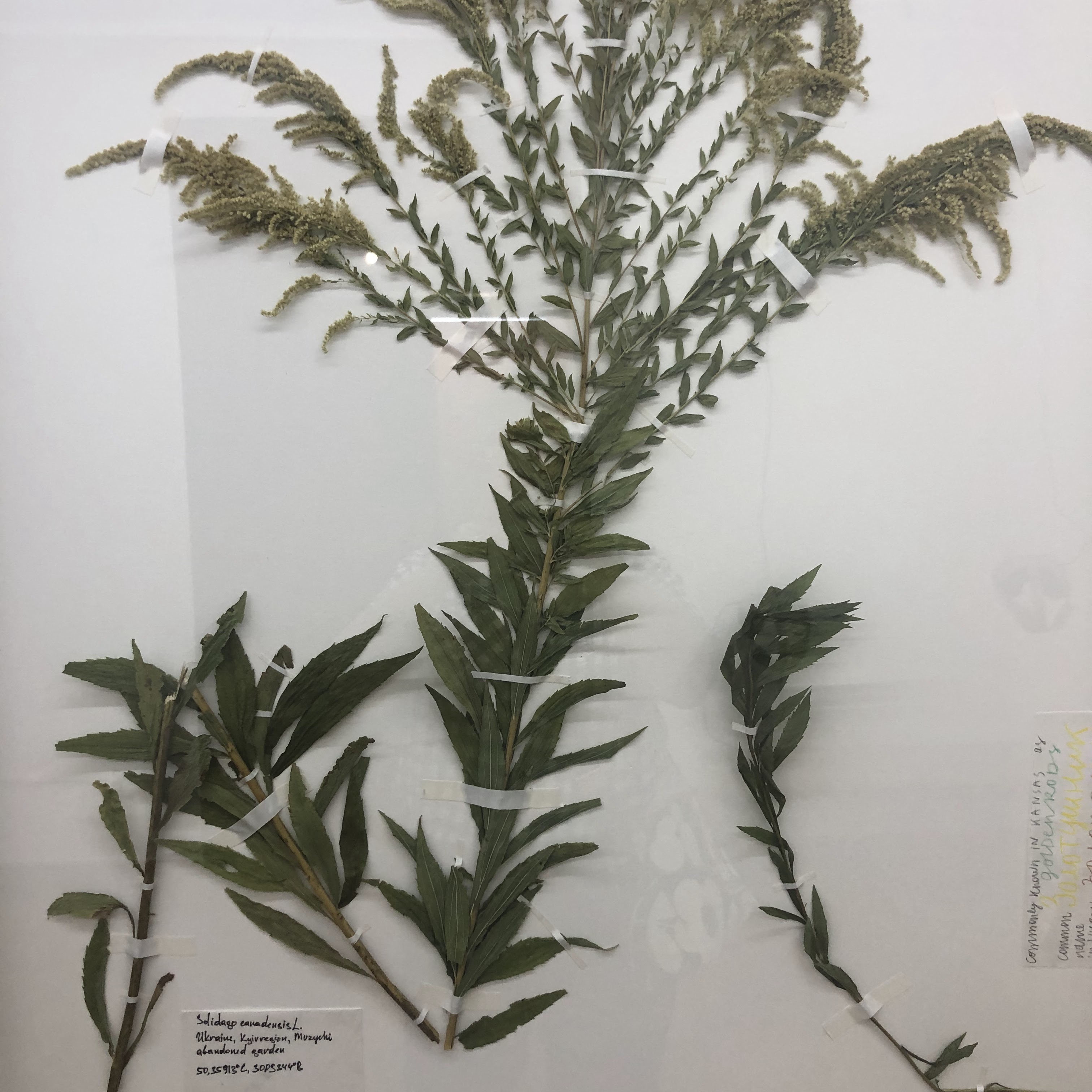


The work of Alevtina Kakhidze from Ukraine, "Invasion, 2022"  shared a different kind of narrative.  Her drawings and botanical samples combine to help us understand more about Ukraine's vibrant agricultural life--and at the same time, those plants, she proposes, can be examples for us, spreading around the world.  Plants, she says, "are pacifists as much as possible on this planet. They don't kill each other in an instant; they don't run away either in case of danger." Plants as storytellers!


At a historic hammam, 
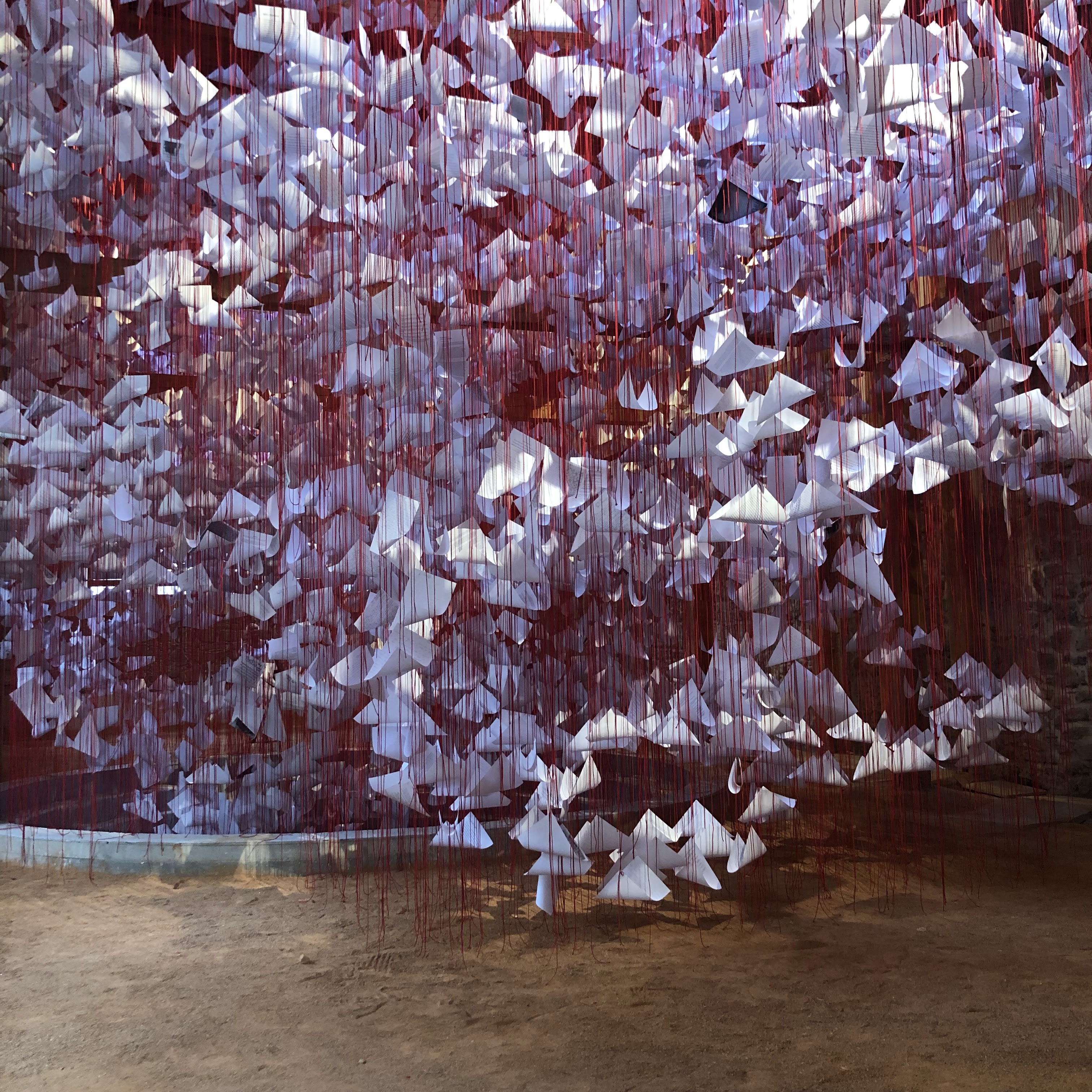
Chiharu Shiota created a work of narratives that I found both beautiful and frustrating.  This installation is composed of hundreds of handwritten memories about the Kosovan war.  But whose are they?  How are they collected? How are decisions made about their use?  Is the goal (does art need a goal?) for us just to consider that memories are always a cascade together?


And finally, the
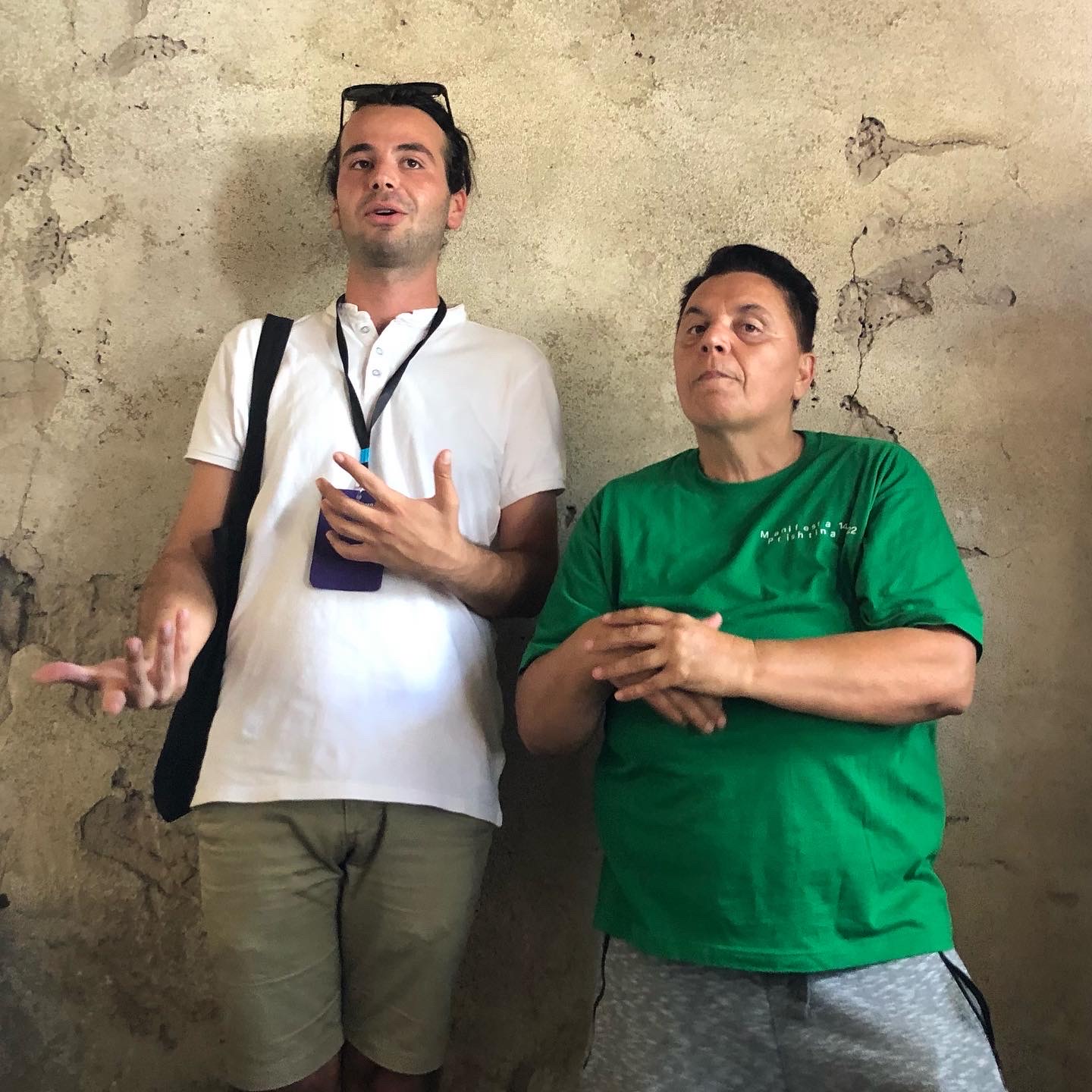
Hertica Schoolhouse and its many narratives provided the most memorable experiences of the trip.  It was the only place we had to take a taxi to, with the driver questioning why we would even want to go there.  In the 1990s, ethnic Albanians set up more than 400 schools in homes, essentially creating a parallel school system to teach in Albanian, which was banned in schools.  Mehmet Aliu-Hertica offered his home for high school students who met there for more than nine years, with classes running in shifts all day long.  The house was damaged by fire and now stands empty.  We were lucky enough to have Aliu-Hertica's daughter (above,right)  join the mediator on our tour to share her own memories and stories.  The future of this building is unclear, but I was struck by the power of this kind of fighting against oppression--not with guns and bombs, but rather with the power of knowledge. 


I saw so many other artists' works I was intrigued by, admired, or in some cases didn't understand at all.  I was particularly drawn to those works that helped me understand more about the city, the country and the region even though so many questions still remain.

As we traveled around the city, we talked about often how these works, using narratives, can inform the work of history museums.  Are we too concerned with only the factual truth?  What is the role of emotions in our work?  At the same time, can we do something that artists cannot?  

Yesterday on Twitter I came across this from writer Hilary Mantel, as part of tributes to her unexpected passing that somehow helped me connect artists and historical narratives. In a 2017 Reith Lecture, she wrote:

Evidence is always partial. Facts are not truth, though they are part of it – information is not knowledge. And history is not the past – it is the method we have evolved of organising our ignorance of the past. It’s the record of what’s left on the record. It’s the plan of the positions taken, when we to stop the dance to note them down. It’s what’s left in the sieve when the centuries have run through it – a few stones, scraps of writing, scraps of cloth. It is no more “the past” than a birth certificate is a birth, or a script is a performance, or a map is a journey. It is the multiplication of the evidence of fallible and biased witnesses, combined with incomplete accounts of actions not fully understood by the people who performed them. It’s no more than the best we can do, and often it falls short of that.

In Pristina, many artists turned  those scraps of history, personal and collective into something new, and for me, helped turn history from just a map, just a scrap, into a journey.  Here's just some other bits and pieces (I notice that I am also attracted to artwork that uses text!)


[Special thanks to Annemarie for asking me along on this adventure and to the many terrific young mediators at every venue.]

Sunday, September 4, 2022

Back to Blogging? On the Road Again


For more than a decade, I blogged regularly--I aimed for once a week.  But, since the start of the pandemic in March 2020, I have managed a measly total of 8 posts, with absolutely no posts since May 2021.  Every once in a while, I think about it, and don't quite manage it.  It's been a time of change for sure--I shifted to a new position at the International Coalition of Sites of Conscience in November 2020 and last year, undertook my non-travel personal project of driving every road in the county I live in--something that proved unexpectedly joyous.  But I think I should jump back in.  I certainly can't promise every week, and for sure, it seems that blogging may be out of style. Is it?  Should I be making Tik-Tok videos?  Doing a newsletter? But blogging it is--and I'm jumping back in with a travel post.

In August, I joined friend and colleague Annemarie DeWildt for a road trip through the Balkans to Manifesta 14 in Pristina, Kosovo and then on to the ICOM Triennial meeting in Prague. Manifesta is a roving contemporary art exhibition, held, I think, every two years.  Believe it or not, I saw an earlier iteration in St. Petersburg, Russia, which seems a lifetime ago. I'll come to Manifesta and ICOM in later posts but will start with the road trip.  


Annemarie and I flew separately to Dubrovnik, Croatia, and took a taxi to Trebinje in Bosnia and Herzegovina (first border crossed).  We overnighted in Trebinje and met the guy who was renting us his car.  Off we went, a bit bumpy at first.  Our first stop was an artist residency in, literally, the middle of nowhere, to the artists' residency Kamen run Kostana Banovic, a friend of Annemarie's. The residency on the shores of a man-made lake and when we arrived, much back and forthing to set up a screen directly on the shores of the lake to show a film by Vita Soul Wilmering. In some ways, this lovely and moving film set the tone for the rest of the trip. Vita uses Dutch tourist films of the former Yugoslavia overlaid with narration by a local man, observing what he says--they are not from here, he says, they are from here, he says about another shot. Who's from here, who's not from here, who belongs and who doesn't were thoughts that continued to resonate as we crossed more borders (Bosnia/Montenegro;  Montenegro/Albania; and Albania/Kosovo) in a single day's drive.   We drove along, up and down mountains, alongside lakes and broad fields, passing roadside watermelons for sale, over and over (and even spotted a watermelon on the walls of a mosque).


We made a stop for lunch in Prizren, Kosovo, which was full, full full of tourists.  But we came upon a quiet corner with a mosque--and a shaded courtyard of kids, including girls, playing soccer and dashing in and out of the mosque, respectfully putting their shoes on and off each time. It made a tourist-filled city seemed like a real place, the place that people lived and cared about. At another stop at a church, we couldn't enter, but the guards, once they learned Annemarie was Dutch, wanted to chat about Dutch footballers from earlier eras.  

It wouldn't be a road trip without a little car trouble, and we put-putted into Pristina under much-diminished power.  Luckily, our Airbnb host recommended the Volkswagon/Mercedes dealer for repairs to our VW Gulf.  In the morning we arrived at the dealer's and explained the issue, with the help of another customer, who, as it happened, had gone to school in Tulsa, Oklahoma.  After a bit, they come out with the news.  The car was twenty (!) years old and this shiny new dealership didn't carry parts that old, but they made a temporary fix.  

Manifesta in the next post, but some observations about travel these days.  We found Pristina to have the nicest people of almost anywhere I've been.  Someone asked me not long ago how I managed in countries where I didn't speak the language (which, to be honest, is pretty much everywhere).  I still remember, pre-smartphones, all the maps that people had to draw me my first year in Kyiv, to do the simplest things!  Pristina had, it seemed, a large number of English speakers, and that, combined with their friendliness, made it really easy.  Annemarie and I were sitting outdoors at dinner one night, trying to figure out why to order from an Albanian-language menu.  The woman at the next table leans over, and says, "can we help you?"  She and her husband explain all the dishes, explain which ones are mostly local, pulls up pictures on her phone so we can see what they look like, and as well, tells us that her mother, sitting with them, makes some of the dishes the best. It's lovely to be back traveling again, and this trip reinforced for me that it's not the big destinations or sights that make it worthwhile, it's the kids in the mosque courtyard or the friendly family next to us at dinner.  

This is an immensely complex part of the world, with the former Yugoslavia now divided into seven countries. For centuries differences have been exploited, often by those outside the region, and wars are within living memory of most people. But at a time when the world seems ever more fractious and despite the many borders we crossed, this trip was a hopeful reminder that there might just be more things that bring us together than we think. (And oh yes, we made the round trip safely back to Trebinje).


For those map-lovers among you, here's the route we drove.


Sunday, May 23, 2021

Most Useful: Community Engagement


I've just wrapped up another semester of the course, International Experiments in Community Engagement for the Johns Hopkins Museum Studies Program.  It's a bit of an unusual course, in which students each semester work in teams with a museum from somewhere in the world that is not the United States to develop community engagement plans for that museum.  So to begin this post, many many thanks to the staff at the four museums who worked with us this semester:  


Four very different museums, four very different places, four very different resources and connections.  But together, they give students the chance to step outside their own country-specific knowledge to push the boundaries of their learning!  And another big shout-out to all of my students this semester, who persevered, despite illnesses, a new baby, layoffs, and much more to all graduate!

I work to update the assigned readings every semester and rely heavily on sources that are not in journals or otherwise hard to access.  At the end of each course I ask students to tell me about the readings/videos they found most useful. I thought perhaps some of you readers might also find this useful.  I try and stay up-to-date, but one video and one reading get mentioned every year.

Angela Blanchard's 2011 Tedx Talk gets mentioned every year by students. This year, one student wrote,   "Her ideas about working from the existing assets of a group, and using these to then build community engagement were quite formative, both in my individual work and the ways in which the Baia Mare team approached our shared projects.  Though this video is now 10 years old, I believe her ideas and the questions she asks (“What works? What do you have?  What are your strengths?”) have really stood the test of time."

An oft-divisive reading but one I still continue to assign is Sherry Arnstein's Ladder of Participation (1969!) because of student comments like this: "It really pushed the limits of my understanding for how institutions should collaborate with their communities. Even my most ambitious ideas still only reached partway up her ladder, and it made me realize how much my imagination has been unconsciously foreshortened. Although the article is dated in many ways, it still struck me as one of the most visionary and bracingly uncompromising guideposts in the semester."

Many students were appreciative of the thoughtful ways in which writers/activists/thinkers/fellow colleagues held museums to account and projected different futures.  Useful readings (and reasons why):

" "We Don't Need New Models, We Need A New Mindset" by Karina Mangu-Ward

challenged how we approach our museum work and the models we've relied on that no longer suit the complex problems we face today."


"I also think that Porchia Moore’s article, “Cartography: A Black Woman’s Response to Museums in The Time of Racial Uprising,” was incredibly useful and important. I think it should be included every semester, because she brings up a lot of important points about how BIPOC, particularly Black women navigate the museum world and we (especially White people) need to be aware of how experiences can vary based on race, gender, etc. and how they intersect."

Although it is from 1988, this piece is still setting the table for conversation! "Elaine Gurian's The Museum as a Socially Responsible Institution because it really opened up a great discussion on to what different kinds of museums should be doing to both support and care for their audiences." 


Readings that focused on the practical also got some recognition. "The Community Building Workbook is a useful and practical tool for planning community-based programs. I know I’ll be referring to the worksheets and templates for future planning." Said another, "Week 5’s 2020 survey posters developed by Susie Wilkening are crucial in understanding our polarized society and how museums can use this information to inform decisions regarding programming and exhibits."


I do ask students to read the first chapter of Rainey Tisdale and my book Creativity in Museum Practice because I continue to believe that we all need to understand and develop our creative practice to shape better museums and to be in greater service to our communities. It's great to hear that they continue to find it useful!


Duds this semester? I tried teaching logic models for the first time to really get at issues of impact. Big fail on my end, so if you have some great reading about logic models, please share. One reading I'll be dropping because it feels like the field may have moved on is Judith Dorbryzinski's negative take on crowd-sourcing museum exhibitions from 2016.


But what am I missing? When you think about museums and community engagement, what readings or videos inspire you? Let me know in the comments!


Saturday, April 10, 2021

Looking at Layers


It's been a full year at home--which for me is a small hamlet in Delaware County, NY in the northwestern Catskills.  I've been able to spend it here, zooming away, socially distancing with a tiny group of friends, and trying to get out for walks every day (okay, not in the deepest winter!).  But as spring approached this year, for some reason I decided to take on a new project.  This spring (until June 21) I am working on driving every single road in this very large county of 1467 miles.  

It's a county where I used to drive a great deal.  At the start of my museum career, I was director of the local historical association and went everywhere--speaking at a Masonic Lodge in Hancock, going to hearings about watershed protection, driving down dirt roads to look at an artifact for donation, undertaking a project of mapping barns in towns, and spending a week at our tent at the Walton Fair.  But my career path has taken me far away from this so I thought it might be both fun and interesting to do a bit of exploring (if you're interested in regular updates, follow me on Instagram at @lindabnorris).

As you can see from this map, I've got lots to do.  I'm appreciating having a paper map and am marking roads driven as I go.  And, as you can see, I am less than systematic about it!  It's a beautiful place.  Despite being only a few hours outside New York City, it is a really rural place.  Those 1467 square miles only contain about 44,000 people. We tried to count stoplights in the county the other day, and I think there are less than ten.  With rolling farmland,  the branches of the Delaware River, and small towns, there is always something to appreciate.

But what am I am really appreciating is how many layers I can see as I look (also making me appreciate my time at the historical association).  Probably the last eel weir on the Delaware River down near Hancock combined with streams with great trout fishing demonstrate the ongoing importance of water to the local community while a tiny cemetery up on a hill near the Pepaction Reservoir demonstrates how important that water is to others.  The cemetery contains the graves from cemeteries relocated when the reservoir, which provides water to New York City, was built.   That reservoir is not far from Andes, the epicenter of the Anti-Rent Wars of the 1840s, a rebellion against large Hudson Valley landowners.

It's also the time of year when all of your senses can be engaged:  with the car windows open, I've driven through the sweet steam of a sugar shack and the spreading of manure (not a bad smell, it's a sign of farming!) the peepers (take a listen) are out full force every time I drive by a pond, and when I get out of the car to check out a stone wall or a stream, the leaves crunch beneath my feet and I gently touch the lichen on the top of the stone wall.

There are still some dairy farms in the county, but far fewer than their heyday and many farmers maintain those barns with a great deal of pride.  At the same time, new growers and makers are coming to the county, bringing change once again.  This tiny milkhouse was a place where milk was picked up, for transport to a creamery, and eventual transport by rail to the city.  The stone walls up in the woods and places like the abandoned farmstead we found at the end of a dead-end road, dotted with daffodils, all represent the multi-layered place I continue to see as I drive.  Road names and names on a map that are now often just a house at a crossroads testify to the multi-layered of industry and community:  Steam Mill Road, Deposit,  Blue School Road, and many more.  

The landscape also shows me the complex web of economic relationships and income disparity.  Delaware County's per capita income is $27,201 compared to the average US per capita income of $59,279.  For more than a century, well-off New Yorkers have been coming here for rest and relaxation.  Although grand hotels no longer exist (see this sad example below),  there are many big new houses on back roads, built by second-home owners.  The pandemic has meant that real estate is booming--but what does that mean for those locals starting out who would like to own a home?  Can new businesses opened by newcomers boost the economy in a permanent way?  Are there ways to bridge economic and political differences?


But this project isn't about finding answers.  Instead, I'm finding both more questions and a great deal of joy as spring arrives up and down these hills and valleys.


Saturday, March 20, 2021

Meet the 2021 Mentees!


I'm already several months into great conversations with the 2021 mentees, so it's long past time for me to share them.  To begin. however, my deep thanks go to all of you who took the time to apply.  It's wonderful to read about your work, your hopes, and ways you're going to change the museum field--and the world.  Thank you all!  The choice is always very difficult, but here are the folks I'm in conversation with this year.


Anna Stratton is completing her MA in History Museum Studies at the Cooperstown Graduate Program this semester.   She comes to museum work from a bit of a surprising place--the cooperative grocery industry.  We've already had some great chats about the ways in which that work--focused on together, the public, the workers, and the mission--can translate into museum work.  Although she was first attracted to the museum field through textile conservation, as a maker herself, she found a shift underway in her thinking.  When I asked applicants to respond to the question, "What are you passioante about?"  she responded:
I am passionate about many things, but it’s no coincidence that I am embarking on a career in the museum world just as conversations about racial justice abound. I am most passionate about racial equity. As a mixed white and Latina woman who grew up in a diverse city, I have always been keenly aware of racial differences, maybe due to the regular “What are you?” question directed at me throughout my life. I have straddled the uncomfortable grey area of being a person of color with a lot of white privilege for as long as I can remember....to be honest I didn’t realize what a non-negotiable this type of advocacy was for me until a few years ago, perhaps coinciding with…ahem…an emboldened white supremacist state. My reaffirmed commitment to antiracism blossomed simultaneously with a deep understanding that I needed to change careers.

Needless to say, it's a tough time to be finishing up graduate school from home and job hunting at the same time.   Anna's interested in development work and is currently interning remotely with Eastern State Penitentiary, along with working on a virtual exhibit on sugar cane workers in Puerto Rico as part of her coursework.  What's the change she's working towards in the field? "It seems so clear and unambiguous to me what museums must do, but first they must outgrow the idea that they are essentially separate from their communities. There might be a lot of problematic history to uncover, but this, too, must be museum work."

From a mentee who's going to school less than an hour from my house, to one much further away.  Anais Walsdorf is currently based in London.  What is she passionate about? 

I’m most passionate about amplifying voices and histories that have been and continue to be silenced, especially colonial histories and their present-day iterations and legacies. I spent most of my childhood growing up on a small island in the Philippines. In the past two decades, I’ve watched how tourism and development have caused immense damage to the environment and the local and indigenous communities. From an early age I was aware of this and the role of money and power in how quickly my home was changing.

Anais is a Visitor Experience Assistant at the Wellcome Collection, a position that has maintained throughout the pandemic lockdowns.  She's worked on a new label putting Napoleon's toothbrush in the context of colonialism as part of a larger project of rethinking permanent exhibits and is also working on team crafting guidelines for supporting researchers using collections related to trauma.  Pre-lockdown, she was also a Gallery Supervisor at the Migration Museum in London and a volunteer with the Museum of British Colonialism.

What would Anias jettison from museums?  "we absolutely need to abandon traditional understandings of what a museum is, and any arguments keeping Western museums from beginning processes of repatriation and restitution."  Another focus of her interest is that the pandemic laid bare, as it did for so many,  "the precarious position of Front of House workers, contractors, and cleaners, despite their being essential to the working of institutions and being the most high-risk."

In her application, Anais mentioned how much she missed the ways in which teamwork, those informal conversations, really lead to creative ideas and actions.  Me too.  And every year, this small mentor program provides me with new ideas and inspiration, widening my circle of colleagues.  Thanks Anna and Anais!


Friday, January 1, 2021

Hate Group Projects? You're Not Alone. Here's Help


“People are people. And people are problems. But – and this is a very big but – people who are practiced in collaboration will do better than those who insist on their individuality.”

                                                                                                   Twyla Tharp

To be honest, I love group projects.  If you've ever worked with me, you know I love puzzling out how to work together, how to work with thinkers very different than me (shout-outs to Rainey Tisdale and Braden Paynter here), the luxury of celebrating together when an exhibit's done   No team project is ever perfect, but I like the process and try to learn something every time.  Don't get me wrong--I've had some big team failures too! Once, lawyers had to negotiate a credit label in an exhibition. 

To begin the year, I wanted to share some lessons learned from my students this past semester. I teach in the online Museum Studies and Cultural Heritage programs at Johns Hopkins University.  The program is almost entirely online, so not much pivot was needed over the past year, except for an increased understanding of the pressures students (many with full-time jobs and children) were facing.  This past semester though, many students had originally planned to take the in-person seminar in exciting places which were,  of course, canceled.


My courses always involve a group project, where a team of 3-4 works together over the entire semester.  This past semester they worked in teams as "consultants" to ARCH, a non-profit organization working to preserve a synagogue and shrine in Iraq, to develop interpretive plans  Neither the students nor I had much knowledge about this site or about the culture and history of Iraq when we began.  

At the end of every semester, I ask students to write a reflection about their learning path in the course, and how they would use those learnings moving forward.  This semester, students wrote extensively about the process of group work, many admitting that they approached a semester-long group project with a great deal of trepidation.  Wrote one, 

"Reflecting on previous group assignments, during my previous degrees and professional life, I was concerned about potential clashing of personalities, uneven workloads, poor time management, and more. With all of these concerns, I entered into this course rather anxious. Yet, I remained hopeful."

Another student wrote, "My disappointment [of no in-person seminar] turned to concern when I learned that the course replacing the seminar would be largely based on group work, something I have not had a great experience with in this program."

How did teams get over that uncertainty that so many felt? Here are a couple approaches that they found that may be useful to each of you.

What kind of team member are you?

Students were asked to read this article on team member styles. This slightly different approach would work as well. Pre-class, students took then a survey that asked about their team style, along with their backgrounds and interests. I assigned teams primarily on the kind of team player they said they were, building groups with different types. I didn't specifically ask them to discuss the type of team member they were, but sooner or later, they all did.

Consider a contract

Said one student, "I believe that a major contributing factor in this was our group contract. I had never considered creating a contract for a team project before, but I will certainly do so moving forward. The contract allowed us to establish expectations and understand each other’s working style and skillsets early on in the process. Based on this information, our team decided to designate each member as the leader of a project component, with the explicit understanding that all teammates would contribute to all elements. While these roles evolved as we solidified our project format, this exercise encouraged us to address many potential stumbling blocks before they occurred."

Spend time to listen

In the first week, students are assigned readings from Creativity in Museum Practice and asked to respond to a discussion question about their own creative practice. On one team, one team member took the initiative to spend the first week carefully reading over the creativity responses and looking and the teams' likes and dislikes to try to determine who might best fit each role in the project. This resulted in a team member asked to take on a role that she was really unsure about --but, she wrote -- "So it turned out that Samantha had been able to identify a strength of mine that I didn’t even really consider a strength, and she and the rest of the team encouraged me to go out exploring and see what I could find. Because I had this freedom, I was able to really push out of my comfort zone and find things I wasn’t expecting to find."

Be generous (and accountable)


I have never had a group of students write so generously about their fellow team members. But in sum, as one student wrote, "Although we had challenges regarding the assignments and making sure that we were on the right path to success, as a team, we felt confident that no matter what, our team could handle it. We never used ‘inadequacy’ as a framework in challenging each other’s choices or ideas. We were kind, considerate of everyone’s opinions, respectful to allow everyone’s voice heard, and because of this, we worked together exceptionally well. I never felt ‘dread’ to go into a weekly meeting."


One team did struggle a bit, but at the end, one of those team members still wrote, "The course also really reinforced my belief that the depth and quality of what can be achieved when museum colleagues collaborate around common goals will always transcend what can be done by one individual with a singular creative vision."


Make time and have a plan


These students used so many different methods of working together: Zoom calls, What's app, text messages. Groups held weekly meetings and although each team approached the meetings differently, the regular meetings were important unifying forces. One team began meetings by each sharing something about themselves--I can't remember the specific question but I know in one meeting I sat in, one student's answer was The Golden Girls. You need to know people as people before you can work together effectively--particularly important as many of us continue to work virtually.


Look inside


Effective teamwork means that you have to know yourself, and to be open to learning new things--about yourself and others. "Recognizing my own privilege, as a person who researches and writes from the comfort and safety of my home, was an imperative daily ritual task that informed how I approached the intricacies of interpretation on this project," wrote one student. Another observed, about the challenge of working on a site we all knew little about, "While this [a particular topic] was a challenge, I understand that it also reflects real-world circumstances: perfect, deliverable data sets are rare no matter what field you operate in!"


Take Satisfaction and Find Joy  

"Bluntly, what I was craving was action and conversation, and perhaps, personal affirmation that I had not traveled the wrong road.  Having arrived at the conclusion of the course, and simultaneously my degree program, I can say with certainty that the Museum Projects course has been the most beneficial educational experience of my graduate career."

"However, this semester turned out so much better than I ever could have anticipated and now I feel quite silly for spending so much brainpower and time worrying about it."


"It was wonderful being a part of something that felt a lot like that creative museum I’d read about in the first week of class."


I'm far from a perfect teacher: Blackboard bedevils me, I hate formatting, sometimes I make big leaps or assumptions that are hard to follow. But this semester brought much joy as I watched these students find joy as they grew in their personal and professional capabilities. I hope some of you will try out these strategies in the new year--bravo to all my students!


Sunday, December 13, 2020

What a Year! Need a Mentor for 2021?


For seven years, I posted an annual call inviting applications for someone in the museum/archives/preservation fields to work with me in a year-long mentorship.  It was an incredible privilege to get to know one or two new people each year.  The mentees have been graduate students, young professionals, mid-career professionals; educators, curators, directors, archivists, and more.  I'm so happy that I'm still in touch with many of them. This year alone one got back in touch with book publishing news; another to ask a question about approaching a particular job and another to share her own progress at her museums.  During their mentorship year, they lived or worked all over the world:  Cambodia, Denmark, the UK, New Zealand, and of course the United States. (Shout-out to all of you!)

Tania Said, a mentee in 2017, shared her reflections from the perspective of a few years:

Having a year of structured mentoring with Linda Norris was a window into seeing what I didn't know. It was a chance to more closely examine the contrast in the museum field and the many shades of grey in between. She helped me become more intentional in my museum practice while preparing me for my next chapter. Our monthly conversations helped me grow in my work and kept me grounded at the same time; in fact, I attribute my career change to the seeds we sowed. Even today, Linda continues to be a supportive and trusted colleague.

Last year I took the year off.  I didn't have a particular reason but just felt it was time for a break.  2020 had surprises in store for all of us. After some reflection time, I'm happy to announce the return of my small mentorship program for 2021.  It seems like a great time for all of us to expand our networks, think together, and plan for change. I hope a chance to sit down, virtually speaking, with me once a month might be of use to some of you.  It’s a two-way street for me--from mentees I have learned to look at museum work from different perspectives;  I have learned about specific work in different contexts; and about the ways each of us approach challenges and opportunities and think about next chapters.

About Me
I've been a sporadic blogger this year, so for those of you who might be coming here for the first time--here's a bit more about me. I’m a white-cis-gender woman--I use she/her/hers. Currently, I am Senior Specialist, Methodology and Practice at  the International Coalition of Sites of Conscience where I have worked for four years. In addition, I teach in the online Museum Studies and Cultural Heritage Programs at Johns Hopkins University.  Before joining Sites of Conscience, I spent a considerable amount of time as an independent museum professional, working with museums and historic sites in the United States and Canada.  More than a decade ago, I was a Fulbright Scholar to Ukraine, a place that continues to engage me on so many levels as history is made and re-thought.   With my dear colleague Rainey Tisdale, I'm a co-author of Creativity in Museum Practice and work to embed creative practice in museum work every day.  If you want to do more than read about me, you can watch my interview with Paul Orselli or listen to me chat about Sites of Conscience with Dan Snow at History Hit.  And of course, check out previous entries here. 

What Does the Mentorship Look Like?
We'll schedule monthly conversations at times convenient for us both. You can apply for the mentorship no matter where you live or work or what stage of your career you're in. I'll expect you to be both a good listener and a good questioner--and be willing to look at yourself deeply. I'll ask for one or two blog posts over the year on deadlines we mutually set and of course, I also expect active participation and questioning when we talk. In addition to the monthly conversations, I'll provide feedback, introductions as I can, and loads and loads of opinions! 

What Makes a Good Mentee?
I'm interested in people who have entered the field from different directions and who bring different perspectives to the work.  I particularly want to encourage BIPOC students and colleagues to apply.  The cultural field has deep work to do to ensure that our work is equitable, inclusive, and just and one of my goals is to contribute.  For colleagues outside the US, sadly, I only speak English, but you can be from anywhere in the world because we can always work out the time zones! I  know that many of you may be out of work and trying to figure out what's next. You do not have to be working in the field right now to apply. Applicants should be curious and willing to engage in conversations that are sometimes challenging (for both of us).  If you want to learn a specific skill--say, how to be a consultant, or how to catalog an object, this is probably not the opportunity for you.  But if you work, or want to work, in any aspect of museums, cultural heritage, archives, historic preservation or memory work, consider applying.   

Okay, I'm In! How do I Apply?
If you're interested, send me an email (linda at lindabnorris.com)  with the subject line "mentorship: [lastname]" by January 6, 2021, that includes two attachments: your resume and answers to the following questions:
  • What are you passionate about?
  • What questions would you like to discuss with me during the year?
  • What was an early creative act? (I mean, not in work, but early, as in childhood)
  • In terms of your work life or studies, what learnings will you take forward from 2020 and what aspect of museum or cultural heritage work could be jettisoned?

How Do I Decide?
Because this is my own individual project, I get to make my own decisions, sometimes with the counsel of a few trusted colleagues. For instance, I'm probably not very interested in you if your key questions are about becoming a consultant.  I want to be challenged and intrigued, I don't care about your Meyers-Briggs type or your grades in graduate school. I appreciate people who don't take themselves too seriously.  I love curious people. I want to get off that Zoom call every month ready to think more about your work and my work and the ways we can make change together. Museums have a larger role to play in this complex world--but only if we dig in and get at it.

Special thanks to Mia Jackson for her thoughts on this post.